
कृपया इसे हिंदी में पढ़ने के लिए यहाँ क्लिक करें
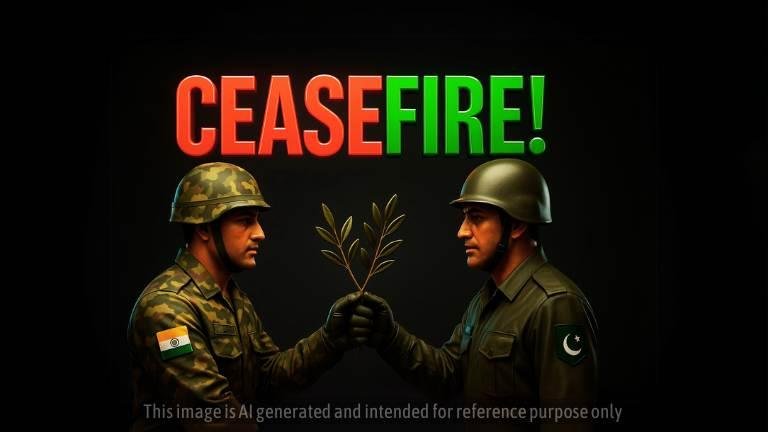
On May 10, 2025, India and Pakistan agreed to a full and immediate ceasefire following days of intense cross-border hostilities in the disputed Kashmir region, brokered primarily through U.S. mediation by President Donald Trump and Secretary of State Marco Rubio, with secondary support from Saudi Arabia and Turkey. The truce came after a deadly militant attack on Indian tourists in Kashmir on April 22, which India blamed on the Pakistani-backed Lashkar-e-Taiba group, leading to retaliatory missile and drone strikes on both sides that caused dozens of civilian casualties and significant displacement. Despite the official ceasefire, sporadic violations were reported just hours later along the Line of Control in Jammu’s Palanwalla sector.
Background and Historical Context
The 1949 Karachi Agreement
- In July 1949, India and Pakistan signed the Karachi Agreement, establishing a UN-supervised Cease-Fire Line (CFL) in Jammu and Kashmir, monitored by the United Nations Military Observer Group in India and Pakistan (UNMOGIP) since 1951.
- The agreement stemmed from Security Council Resolution 39 (April 1948) to end the first Indo-Pakistani war (1947–48) and outlined procedures for demarcating positions and investigating violations.
The 1965 War and Tashkent Declaration
- The Indo-Pakistani War of 1965, prompted by Pakistan’s Operation Gibraltar, saw large‐scale tank battles and lasted 17 days.
- Hostilities ended after UNSC Resolution 211 (September 1965) and the Tashkent Declaration (January 10, 1966), brokered by the Soviet Union and United States, which mandated a ceasefire and mutual withdrawal of forces.
The 2003 Ceasefire Pact
- In November 2003, both nations signed a ceasefire along the Line of Control to stabilize tensions, leading to resumed bus and trade links in Kashmir, though violations persisted, especially after 2017.
The 2025 Escalation and Ceasefire
Triggering Incident
- On April 22, 2025, a gun massacre of Indian Hindu tourists near Pahalgam in Indian-administered Kashmir resulted in over a dozen civilian deaths, which India attributed to Lashkar-e-Taiba terrorists.
Military Exchanges
- India launched missile strikes on multiple Pakistani airbases, prompting Pakistan to retaliate under “Operation Bunyan Ul Marsoos,” targeting Indian military installations.
- Over 50 civilian casualties and mass displacement occurred on both sides, with infrastructure damage in border villages and towns.
Ceasefire Announcement
- President Trump and Secretary Rubio announced the ceasefire on May 10, 2025, underscoring that “both sides agreed to de-escalate conditions” provided no further attacks occurred.
- Secondary mediation by Saudi Arabia and Turkey bolstered the agreement, with both Islamabad and New Delhi expressing tentative hope for resumed diplomatic dialogue.
Terms, Key Players, and Violations
Key Signatories
- India: External Affairs Minister S. Jaishankar and Foreign Secretary Vikram Misri confirmed India’s compliance and readiness to restore civilian flights once security improved.
- Pakistan: Director General of Military Operations (DGMO) Lt Gen Nazar Ali and Foreign Minister Bilawal Bhutto-Zardari affirmed Pakistan’s willingness to maintain the ceasefire but warned of reciprocal action upon violation.
Early Violations
- Hours after the truce, Pakistan was accused of firing on Indian positions in Jammu’s Palanwalla sector, prompting orders for the Border Security Force to retaliate “with full force” against any breach.
- International actors like the G7 and China urged both sides to “uphold the ceasefire in letter and spirit” to avoid a slide into all-out war.
Ground-Level Impact
Civilian Hardships
- In Kashmir’s Kupwara and Baramulla districts, villagers reported shattered homes and loss of livestock due to artillery shelling, with relief operations delayed by damaged roads.
- British nationals stranded near Srinagar shared harrowing accounts of lockdown conditions, with some families lacking medical supplies amid blocked evacuation routes.
Unknown and Engaging Facts
- UNMOGIP, established in 1949, remains one of the UN’s oldest observer missions, with over 60 years of continuous monitoring along the CFL.
- The Indus Waters Treaty—never formally suspended despite tensions—served as a model for water sharing, though it faced strain during the 2025 escalation.









Leave a Reply