
कृपया इसे हिंदी में पढ़ने के लिए यहाँ क्लिक करें
The Sky Over The Holy City
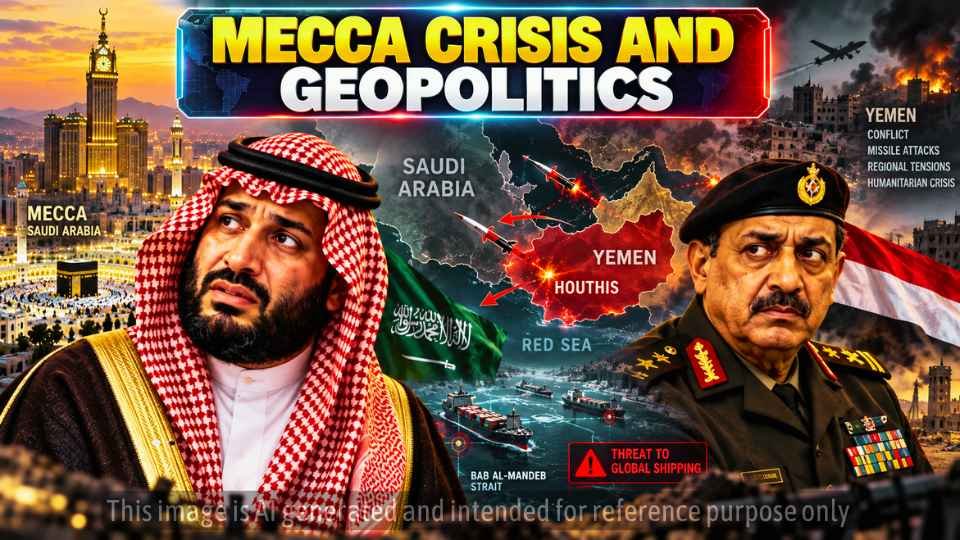
Have you ever looked at a breaking news headline and felt that the loudest narrative is hiding the real story? That is precisely what is happening across West Asia right now. Alarm sirens recently echoed across the holy city of Makkah, along with Jeddah and Taif. Emergency defense systems were triggered, instructing residents to stay indoors and clear the open streets. A short while later, defense forces reported intercepting and neutralizing an armed drone flying south of Makkah before it could enter restricted airspace.
Coalition officials quickly drew a line in the sand, stating that the sanctity of the holy sanctuary, the pilgrims, and the holy city is a non negotiable red line. An immediate wave of international diplomatic condemnation followed, declaring the attempted strike a direct offense against Islamic values and world heritage. On paper, it sounds like an unprecedented sectarian escalation between Shia and Sunni factions. Yet beneath this terrifying flashpoint lies a complex web of regional power politics, economic friction, and survival tactics.
A Strange Denial And A Tactical Contrast
Here is where the puzzle turns fascinating. The Houthi movement based in Yemen took the unusual step of issuing an absolute, flat denial. When they launch attacks on distant military targets, such as King Khalid Air Base, southern industrial ports, or refinery facilities in Jazan and Abha, they openly claim responsibility. They often publish footage, celebrate their tactical range, and frame the operations as retaliation for ongoing blockades.
This time, their tone was completely different. They firmly rejected any accusation of targeting Makkah, calling the claim a political fabrication designed to mislead the global Islamic community. Their reasoning is simple. The holy sanctuary belongs to over two billion believers worldwide, including both Shia and Sunni faithful. Targeting such a spiritual center would be strategic suicide, alienating allies, inflaming global outrage, and turning every Muslim nation against them overnight.
A Brief Backstory, The Birth Of The Royal Shield
To understand why the defense of Makkah is such a powerful rhetorical weapon, we have to travel back in time. Long before modern drones flew across desert skies, an armed insurrection stunned the world in late 1979 when radical insurgents seized the Grand Mosque in Makkah. That event shook the ruling monarchy to its foundations because it directly questioned their divine right to govern the peninsula.
In 1986, the monarch at the time, King Fahd, made an ingenious move. He formally discarded aristocratic titles of majesty and adopted the official designation of Custodian of the Two Holy Mosques. It was a masterclass in political survival. By tying the legitimacy of the dynasty directly to the physical protection of the sacred shrines, any criticism of the government could easily be framed as an attack on Islamic faith itself. The throne transformed from a regular regional autocracy into the self appointed guardian of the spiritual heart of the Islamic world.
The Fragile Pillars Of Dynastic Rule
Any governing dynasty in this resource rich region relies on a few fundamental pillars to maintain order. When you study the political architecture, it comes down to money, internal coercion, external security guarantees, and religious legitimacy. Historically, immense oil revenues funded generous social programs, state jobs, and elite loyalty. A formidable security apparatus maintained domestic discipline. Meanwhile, external superpowers offered a solid defense umbrella in exchange for uninterrupted energy security.
Today, those traditional pillars are undergoing immense strain. Heavy budget deficits, volatile energy markets, and lower export quotas have forced major cuts and postponements to ambitious mega development programs like Vision 2030. Diplomatic relations with Western allies have cooled, while requests for military backing from neighboring regional capitals have met polite hesitation. When financial handouts dwindle and foreign protection looks uncertain, only one pillar remains unbreakable. That pillar is the Sacred Franchise, the moral imperative to defend the holy sites.
A Choke Point Strategy Across The Red Sea
While religion dominates the headlines, physical geography controls the battlefield. The ongoing unrest is concentrated along maritime corridors that sustain the entire planet. Look closely at the maritime maps around the Bab al Mandab Strait and the Red Sea. Commercial vessels, cargo tankers, and crude shipments must navigate these narrow waterways daily.
At the same time, regional logistics networks rely on internal transit lines, including crucial East West crude pipelines that pump energy toward coastal terminals. Rival militia groups in Iraq have applied pressure from the north, naval operations disrupt trade from the south, and tensions simmer across the Strait of Hormuz to the east. The governing monarchy finds itself pressured on three distinct geographic flanks. Framing this squeeze as a sectarian assault on holy ground shifts the debate from strategic policy blunders to an urgent holy mission.
The Psychology Of Public Perception
Consider how domestic populations respond to crises. If an oil facility or pipeline is damaged, ordinary citizens view it as an administrative failure, an economic disaster, or a flawed foreign intervention. People can ask difficult questions about defense spending, military competence, and royal policy.
However, if you convince the public that an adversary is actively attempting to destroy the central altar of their faith, the conversation changes completely. Frustration turns into religious fervor. Discontent dissolves into nationalistic unity. Questioning royal authority suddenly looks like betrayal or blasphemy. It also puts immense pressure on non aligned Islamic nations, forcing foreign leaders to issue unconditional solidarity statements or risk alienating their own conservative populations.
Seeing Past The Sectarian Illusion
It is easy to categorize the conflict as an eternal, irreconcilable holy feud. Doing so lets political actors off the hook. This struggle is not fundamentally about theology, prayer rituals, or ancient sectarian disputes. It is about territorial leverage, maritime dominance, regime continuity, and control over shrinking economic resources. The sacred city is caught in the middle, functioning as the ultimate narrative shield for leaders fighting to safeguard political prestige.
Social Message
True faith unites human hearts in empathy, patience, and mutual respect. When spiritual sacredness is weaponized to justify geopolitical conflicts or stir up hatred between communities, humanity pays the heaviest price. We must learn to look beyond manipulative rhetoric, recognize our shared brotherhood, and demand that sacred ground remains a symbol of peace, spiritual refuge, and reconciliation for all people.
Disclaimer: The information presented in this article is intended solely for educational, analytical, and informational purposes. It analyzes geopolitical developments, regional conflicts, and historical contexts based on publicly documented international affairs. It does not intend to hurt, disrespect, or demean any religious community, national entity, or political leadership.






Leave a Reply