
कृपया इसे हिंदी में पढ़ने के लिए यहाँ क्लिक करें
In a significant policy shift that is set to have a major impact on the pockets of millions, the central government has announced a massive hike in the excise duty on cigarettes and other tobacco products, effective from February 1, 2026. This move marks the end of a seven-year freeze on such duties, a period that began with the introduction of the Goods and Services Tax (GST) in 2017. Let’s light up the details and get to the bottom of this burning issue.
A Fiery Backstory: From GST to a Renewed Excise Duty
To understand today’s news, we must travel back to 2017. When the GST regime was rolled out, it streamlined many taxes. The then-existing excise duty on tobacco was largely rolled back and replaced by a ‘compensation cess’. While the goal was tax simplification, this structure remained unchanged for seven years.
Now, the government is bringing back a strong, dominant excise duty component, signaling a major overhaul in how ‘sin goods’ like tobacco are taxed. While the GST rate of 40% on these products remains untouched, the re-introduction of a heavy, specific excise duty over and above GST is what will drive the prices skyward.
What’s Changing? The Nitty-Gritty of the New Tax
In simple terms, the government’s new policy isn’t a one-size-fits-all approach. It’s a smart, multi-layered tax structure. The new excise duty will be levied per 1,000 cigarette sticks, and the amount will depend on two key factors:
- The cigarette’s length: Simply put, the longer the cigarette, the higher the tax.
- Filter or Non-Filter: Whether the cigarette has a filter also plays a part.
The excise duty will now range from a hefty ₹2,050 to an even more substantial ₹8,500 per 1,000 cigarettes, depending on the specific category they fall into.
A similar, machine-capacity-based excise system is also being introduced for smokeless tobacco products like chewing tobacco, jarda, and gutkha, ensuring they also become costlier.
The Real Burn: How Much More Will You Pay?
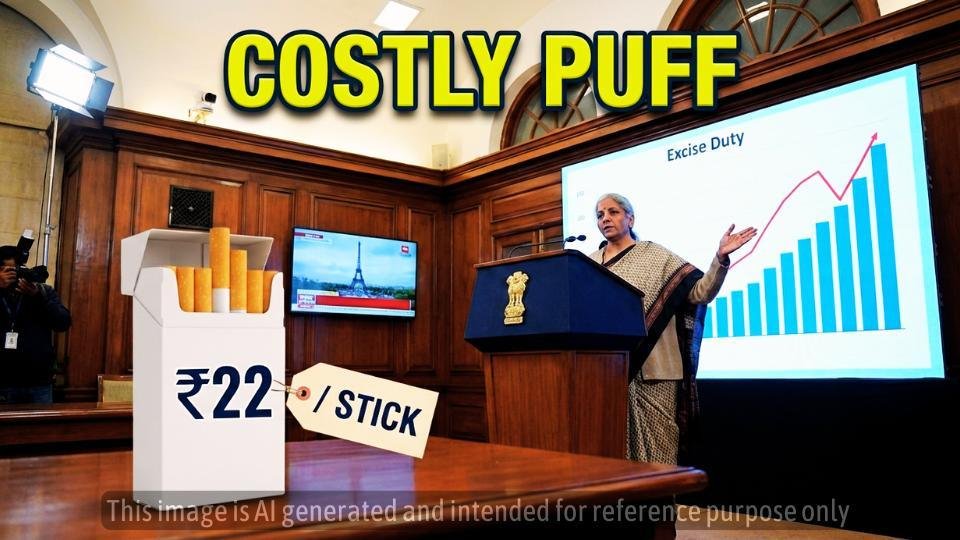
So, how does this translate into real money for the common person? The impact will be noticeable. According to industry estimates, we are looking at a retail price jump of nearly 15-20%.
- A cigarette that currently costs around ₹18 per stick is expected to cost between ₹21 to ₹22.
- Short, non-filter cigarettes (up to 65 mm) will see a tax of about ₹2.05 per stick.
- Long, premium cigarettes (70–75 mm) will carry a much higher tax of about ₹5.4 per stick.
This move is sure to make a standard pack of cigarettes significantly more expensive, affecting the daily budget of regular smokers the most.
Why the Hike? The Government’s Three-Fold Agenda
The government’s decision is driven by a mix of public health concerns, revenue needs, and international commitments.
- Public Health First: This is the primary objective. Tobacco is a major health hazard, causing an estimated 13 lakh deaths in India every year. It is globally recognized that increasing the price is the single most effective way to deter people, especially the youth, first-time users, and low-income groups, from smoking.
- Filling the Coffers: Let’s talk numbers. The tobacco industry contributes over ₹70,000 crore to the government’s revenue annually. This higher tax collection will help offset other revenue losses, fund crucial public health expenditures, and support anti-tobacco campaigns.
- A Global Commitment: India is a signatory to the World Health Organization’s (WHO) Framework Convention on Tobacco Control (FCTC). This tax hike reinforces India’s commitment to this global health treaty. Interestingly, the WHO recommends that at least 75% of a cigarette’s retail price should be tax. Even with this new hike, India’s total tax will be around 53%, still leaving room for future increases.
Potential Risks and A Word of Caution
While the move is well-intentioned, it’s not without potential downsides. Critics point out that this could lead some smokers to shift to cheaper, and often more harmful, alternatives like bidis or loose, illicit cigarettes. It also opens up the risk of an expanded black market for smuggled or counterfeit products. The challenge for the government will be to strengthen enforcement to curb these parallel markets.
A Final Thought & Social Message
This bold step by the government is a clear signal: the health of the nation is a top priority. While it may pinch the pockets of many, the larger goal is to build a healthier, smoke-free future for the next generation. It’s a reminder that sometimes the most effective changes are the ones that force us to rethink our habits, not just for our own sake, but for the well-being of the entire community. Health, after all, is the truest wealth we can possess.







Leave a Reply