
कृपया इसे हिंदी में पढ़ने के लिए यहाँ क्लिक करें
A Deep Dive into Why 93% of Option Traders Really Lose Money
In the electrifying world of the stock market, a startling statistic has become the talk of the town: 93% of options traders lose money. This number, brought to light by the market regulator SEBI, has sent shockwaves through the industry, prompting a series of proposed reforms like banning weekly expiries, increasing margins, and restricting access to Futures & Options (F&O).
From the outside, it looks like a simple case of a risky product needing stricter rules. But is it really that simple? After speaking with over 200 traders who have lost money, a different, more profound story emerges. The problem may not be with the rules of the game, but with the mind of the player. Today, we peel back the layers of data to uncover the hidden psychological truths behind the losses.
The “Get Rich Overnight” Fantasy
The single biggest reason traders fail is the burning desire to get rich overnight. Influenced by flashy social media posts and screenshots of huge profits, newcomers jump into options trading believing it’s a lottery ticket. They see a 2,000 rupee profit on the first day and their brain releases a kick of dopamine, a chemical that makes you feel good. They mistake this initial luck for skill and start believing they can repeat it every day, only bigger.
- One trader shared, “After a ₹1,500 profit in minutes, I thought, ‘My game is over in 2-3 minutes!’” This is the Get Rich Quick Bias, and it’s the first step into a dangerous trap.
The Casino Mindset: Overtrading and Random Trading
Once hooked, many traders develop an “Action Bias”—a feeling that they must be trading all the time. The market is open, so they have to trade. A clear setup? Doesn’t matter. They’ll take a trade anyway, just to be in the game. This leads to:
- Overtreading: Some traders admitted to making 300-400 trades in a single day! Even if you break even on the trades, the brokerage and taxes eat away your capital.
- Revenge Trading: You take a small loss. To recover it, you take another, bigger trade without a plan. That also results in a loss. Now you’re in a “Loss Aversion Loop,” desperately trying to get your money back, but only digging a deeper hole.
The Most Dangerous Fuel: Borrowed Money
This is where the story turns tragic for many. When their own capital is gone, traders turn to loans, credit cards, and even borrow money from family and friends. This creates a psychological state of “Desperation Bias.”
- One guest on our podcast, a 26-year-old, took on ₹18 lakh in loans to trade. Another took ₹5 lakh from his father after suffering a huge loss.
- Trading with borrowed money is like trying to put out a fire with petrol. The pressure to not lose is so immense that it guarantees you will make the worst possible decisions.
The Illusion of Knowledge
Options trading is arguably the most complex segment of the stock market. It requires a deep understanding of concepts like Time Decay (Theta), Option Greeks, and IV Crush. However, most newcomers jump in with zero education.
This is the Dunning-Kruger Effect in action: a psychological principle where people with low ability at a task overestimate their ability. A little knowledge feels like a lot, giving them false confidence. As one trader confessed, “I didn’t even know what Nifty or Bank Nifty was… I just knew that if the market goes up, I buy a Call.”
The Enemy Within: Psychological Traps
Ultimately, the biggest enemy for a trader isn’t the market; it’s their own mind.
- Ego: “I can’t end the day in red. I must be profitable, even if it’s just ₹100.” This ego prevents traders from accepting a small loss, which then snowballs into a massive one.
- Addiction: The constant thrill and dopamine hits make trading an addiction. Traders feel compelled to be in front of the screen, unable to stop. As one trader put it, “It’s not about the money anymore. I became an addict.”
Hope: The Most Expensive Word in Trading
The final nail in the coffin is “Hope Trading.” A trade goes against you, but you hold on, hoping it will turn around. You get emotionally attached to your losing position (Endowment Effect) and refuse to cut it because you’ve already invested so much money and emotion into it (Sunk Cost Fallacy).
- One trader earned a ₹1 lakh profit over 18 days, only to lose it all—plus an additional ₹2.5 lakh from his capital—in the next three days because he just couldn’t accept the loss.
Are SEBI’s Solutions on the Right Track?
While SEBI’s intention to protect retail investors is commendable, the question is: Will banning weekly expiries or raising margins solve these deep-seated psychological issues? Perhaps not. The real solution lies in focusing on the trader. Better education, mandatory risk awareness exams, a “cooling-off” period for new traders before they enter F&O, and stricter controls on leveraged trading with borrowed money could be more effective.
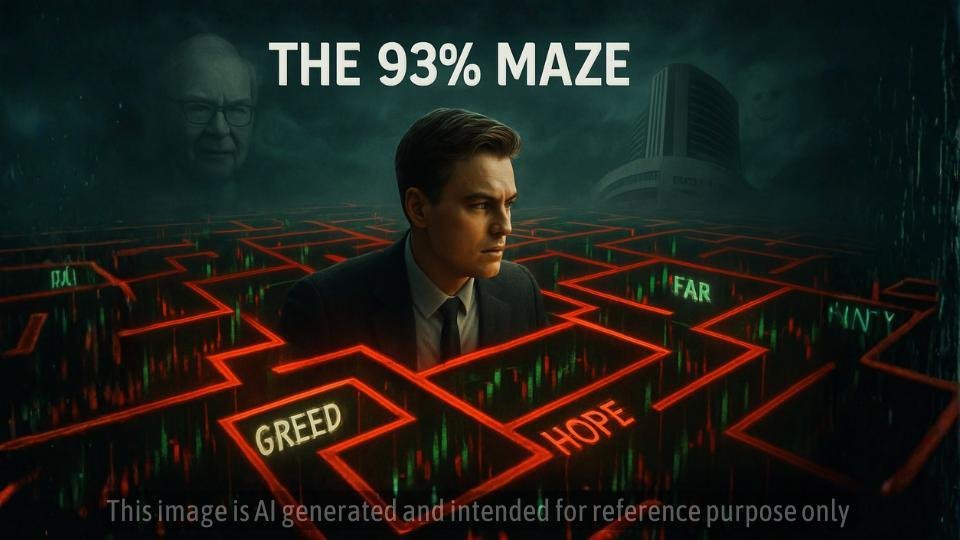
The market will always have new traders. But without addressing the human element—the greed, the hope, the ego—the cycle of 93% is likely to continue, no matter how many rules are changed.
Social Message: The stock market is not a casino or a money-making machine; it is a field that demands discipline, education, and above all, mastery over one’s own mind. The journey to becoming a successful trader is not about finding the perfect strategy, but about building a strong psychological foundation. Protect your capital, but more importantly, protect your mind.








Leave a Reply