
कृपया इसे हिंदी में पढ़ने के लिए यहाँ क्लिक करें
Washington D.C. – When a powerful leader travels to a global capital like Washington D.C., they usually expect a warm welcome, handshakes, and important meetings. However, for Pakistan’s Chief of Army Staff (COAS), General Asim Munir, his recent five-day visit to the United States turned into something quite different. Instead of a red carpet, he was met with a chorus of angry slogans, not from rivals, but from his own countrymen.
What Exactly Happened in Washington?
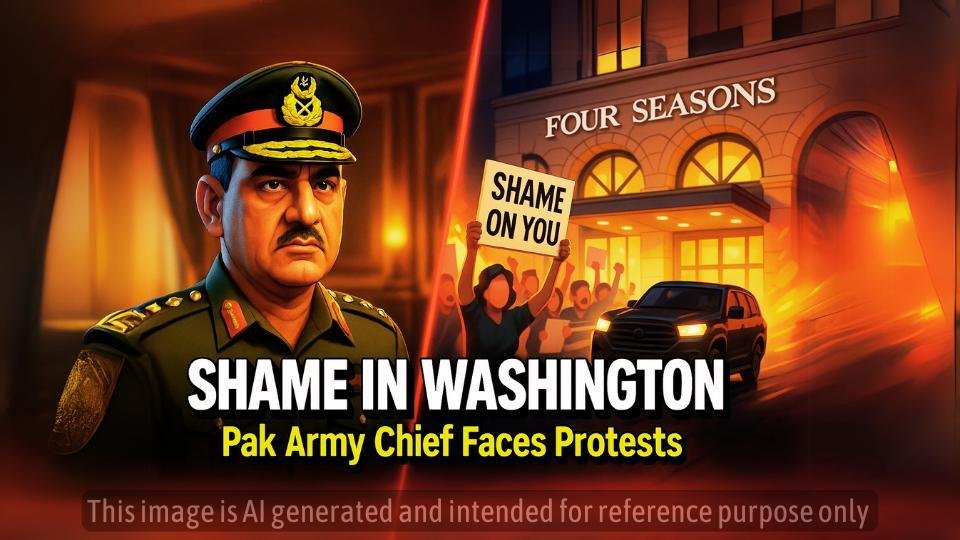
As General Munir’s large motorcade, with its black SUVs and official cars, pulled up to the luxurious Four Seasons Hotel in Washington D.C., a group of protesters was waiting. These weren’t just any protesters; they were members of the Pakistani-American community, many of them passionate supporters of the jailed former Prime Minister, Imran Khan.
As soon as the vehicles arrived, the air was filled with chants of:
- “Shame on you, Asim Munir!”
- “Dictator! Shame on you!”
- “Butcher of Pakistanis!”
- “Free Pakistan!”
- “Civilian Supremacy in Pakistan!”
Some protesters even held up signs and vehicles with messages calling the army chief a “mass murderer” and carrying the slogan, “Democracy dies when guns speak.” The entire incident, captured on video, shows the raw anger and frustration that a significant portion of the Pakistani diaspora feels towards the current military establishment. They followed his convoy, making sure their voices were heard, turning a high-profile diplomatic visit into a public spectacle of dissent.
A Backstory of Embarrassment: The Fake Invite Fiasco
This public humiliation in Washington isn’t an isolated event. It comes right after another major embarrassment for General Munir and his team. Just a few weeks ago, news was heavily promoted in Pakistan that General Munir was the only foreign leader invited by the United States to attend a special military parade marking the 250th anniversary of the U.S. Armed Forces, which also coincided with Donald Trump’s birthday.
This news was presented as a huge diplomatic victory, a sign of Pakistan’s immense importance on the world stage. However, this story quickly fell apart. The White House and the U.S. administration officially denied that any such exclusive invitation was ever sent. They clarified that no foreign leader was specifically invited to the event.
This revelation, first reported by Pakistani news outlets like The Dawn, was a big blow. It appeared to be a case of “fake news” designed to boost General Munir’s image and legitimacy back home, but it backfired spectacularly, leading to widespread ridicule online. A popular meme format featuring a child actor with a confused and disappointed expression, often paired with the text “Rukawat ke liye khed hai” (Sorry for the interruption), was widely used to troll the Pakistani establishment over this blunder.
Why Are They So Angry? The Imran Khan and Civilian Supremacy Factor
The root of this anger lies in the deep political divisions within Pakistan. The protesters are overwhelmingly supporters of Imran Khan’s political party, Pakistan Tehreek-e-Insaf (PTI). They believe that the military, under General Asim Munir, orchestrated the removal of Imran Khan from power and is now leading a severe crackdown on his party and supporters.
They see the current government, led by Prime Minister Shehbaz Sharif, as a “puppet government” installed by the military. For them, General Munir is not a national hero but a figure who has undermined democracy. The chants for “civilian supremacy” are a direct call to end the military’s powerful and often-criticized role in Pakistani politics. They are demanding that the elected civilian government should have the final say, not the army headquarters.
The Bigger Picture: A New Friend in the East?
While Pakistan and its army chief are facing a cold shoulder and protests in the West, an interesting geopolitical shift is taking place. China, Pakistan’s “all-weather friend,” appears to be stepping up its support, not just for Pakistan but also for its regional ally, Iran.
For a long time, China has tried to project an image of being a neutral player in complex global conflicts. However, recent events suggest a change in strategy. In a press release from China’s Ministry of Foreign Affairs, a very interesting conversation was detailed. China’s top diplomat, Wang Yi, spoke with his Iranian counterpart, Sayyid Abbas Araghchi.
During this conversation, the Iranian official thanked China for its “consistent understanding and support of Iran’s position.” More importantly, the Chinese statement went on to “explicitly condemn Israel’s violation of Iran’s sovereignty, security and territorial integrity.”
This is a huge statement. By openly condemning Israel (a major U.S. ally) and backing Iran, China is sending a clear message. It is showing its willingness to pick sides and support its friends—like Iran and Pakistan—more openly, especially when they are in conflict with countries backed by the U.S., like Israel and India. This suggests that as Pakistan’s relationship with the West becomes more strained, it is finding a more confident and assertive supporter in Beijing.
In conclusion, General Asim Munir’s trip to the U.S. has been anything but smooth. It has exposed the deep anger within the Pakistani community, brought fresh embarrassment after the fake invite scandal, and highlighted the complex web of global politics where nations are increasingly choosing sides. For the people of Pakistan, it’s a painful reminder of their internal struggles playing out on the world stage.








Leave a Reply