
कृपया इसे हिंदी में पढ़ने के लिए यहाँ क्लिक करें
A Festive Backstory: When Autumn Brings The Divine Mother Home
Every single year, just as the gentle autumn breeze sweeps across India, homes undergo a hilarious yet beautiful upheaval. Weeks before Sharad Navratri, mothers suddenly notice dust particles that have been happily resting on cupboards for a decade. Brass lamps get scrubbed until they shine like pure gold, closets are turned upside down to assemble nine distinct outfits that match the official nine sacred colors, and family elders argue about who will fast on fruits and who gets to eat the delicious buckwheat puris. Beneath all this joyous chaos lies an extraordinary spiritual truth. Sharad Navratri is not just an ordinary festival. It is a soulful journey of renewing our spirit, welcoming cosmic energy, and learning vital life lessons from the 9 Devi Roops of Maa Durga.
The Essence of Sharad Navratri 2026
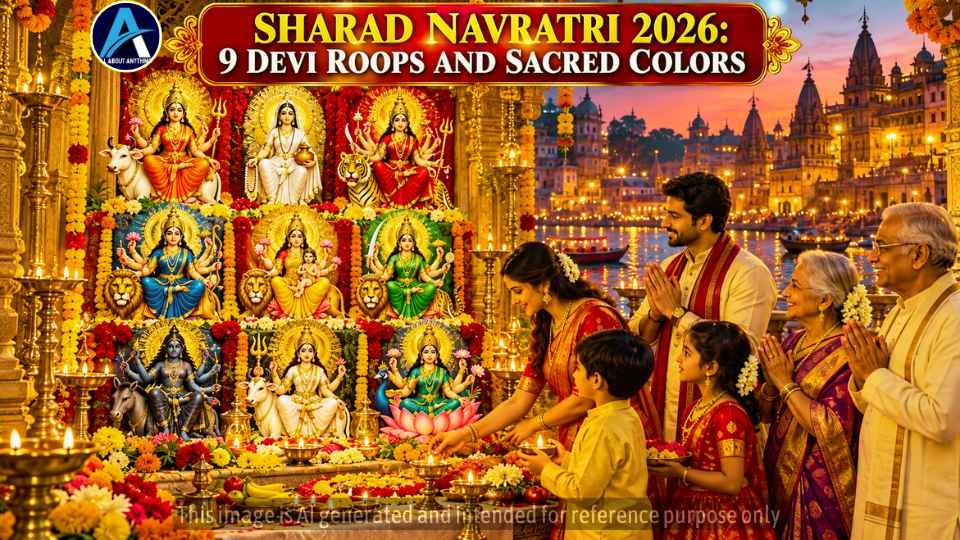
In the year 2026, the grand celebration of Sharad Navratri 2026 begins on Sunday, October 11, 2026, and concludes with the grand festival of Vijayadashami or Dussehra on Tuesday, October 20, 2026. Across these nine sacred nights, devotees invoke the blessings of Navadurga, where each form of the Goddess embodies a distinct virtue, an inspiring story, a sacred color, and a timeless moral compass for our daily life. Whether you are performing Ghatasthapana, participating in energetic Garba and Dandiya, or sitting silently in meditation, understanding each day brings immense clarity and peace.
Day 1: Maa Shailputri, Sunday, 11 October 2026 (Sacred Color: Orange)
The first divine day is dedicated to Maa Shailputri, the noble daughter of the King of the Himalayas, Himavat. Seated gracefully upon a sacred bull named Nandi, she holds a trident in her right hand and a blooming pink lotus in her left hand. She represents pristine nature and absolute stability.
The designated sacred color for this day is Orange, which radiates warmth, enthusiasm, and boundless vitality. In our everyday journey, Maa Shailputri teaches us the value of strength, grounding, and new beginnings. Just like a majestic mountain that stands firm through devastating storms, we must stay rooted in our moral values whenever we embark on a new enterprise, a career change, or a personal relationship.
Day 2: Maa Brahmacharini, Monday, 12 October 2026 (Sacred Color: White)
On the second day, we bow before Maa Brahmacharini, the embodiment of intense penance, pure meditation, and unwavering focus. Walking barefoot, holding a sacred rosary in her right hand and a water vessel in her left hand, she personifies silent determination.
The sacred color for this auspicious day is White, symbolizing purity, inner silence, and spiritual illumination. The core life lessons of Maa Brahmacharini are devotion, discipline, and wisdom. She reminds us that nothing extraordinary is ever achieved without patience and persistent effort. When distractions pull us away from our goals, practicing self restraint and spiritual discipline leads directly to ultimate wisdom.
Day 3: Maa Chandraghanta, Tuesday, 13 October 2026 (Sacred Color: Red)
The third day invokes Maa Chandraghanta, the fierce yet compassionate manifestation of the Goddess. Adorned with a crescent moon shaped like a temple bell upon her forehead, she mounts a valiant tiger and carries ten divine weapons to protect the righteous.
The sacred color of this day is Red, representing fearless passion, unyielding courage, and auspicious energy. Her spiritual guidance centers on courage, protection, and inner peace. In today’s turbulent environment, Maa Chandraghanta teaches us to cultivate inner peace while maintaining the bravery required to defend the weak and shield our minds from toxic negativity.
Day 4: Maa Kushmanda, Wednesday, 14 October 2026 (Sacred Color: Royal Blue)
On the fourth day, devotees worship Maa Kushmanda, whose radiant smile created the entire cosmic universe out of utter darkness. Residing in the fiery core of the Sun, she possesses eight hands and rides a majestic lion, holding weapons along with a bowl of sacred nectar.
The sacred color for this day is Royal Blue, a shade signifying cosmic depth, infinite space, and majestic grandeur. The eternal life lessons she offers are creativity, energy, and abundance. Maa Kushmanda encourages us to realize that creative power resides deep within our soul. Even when circumstances appear completely dark, our optimistic attitude and joyful spirit can light up the entire world around us.
Day 5: Maa Skandamata, Thursday, 15 October 2026 (Sacred Color: Yellow)
The fifth day celebrates Maa Skandamata, the nurturing mother of Lord Kartikeya, who is also known as Skanda, the commander of divine forces. Holding the infant deity lovingly on her lap while resting upon a lotus and lion, she portrays the tender warmth of motherhood.
The sacred color for this blessed day is Yellow, radiating optimism, bright happiness, and divine warmth. Her life lessons focus upon motherly love, compassion, and care. She demonstrates that real power is grounded in tenderness. Caring for our elders, nurturing our children, and showing empathy to those who struggle is the true hallmark of divine consciousness.
Day 6: Maa Katyayani, Friday, 16 October 2026 (Sacred Color: Green)
The sixth day honors Maa Katyayani, the ferocious warrior form created from the concentrated brilliance of all cosmic divinities in the hermitage of Sage Katyayana to vanquish the tyrant demon Mahishasura. Astride a fearless lion with a shining sword, she radiates decisive justice.
The sacred color for this powerful day is Green, celebrating new growth, vitality, harmony, and righteous fertility. Her profound life lessons are bravery, justice, and confidence. Maa Katyayani asks us never to bow before injustice, unfair treatment, or cruelty. She inspires us to discover our inner warrior, uphold fairness in our communities, and stand tall with moral confidence.
Day 7: Maa Kalaratri, Saturday, 17 October 2026 (Sacred Color: Grey)
On the seventh day, the atmosphere deepens as we revere Maa Kalaratri, the fiercest, darkest, and most potent form of Maa Durga. With a dark complexion like midnight, wild flowing hair, eyes flashing with lightning, and seated upon a humble donkey, she is the ultimate destroyer of darkness and demonic forces.
The sacred color of this day is Grey, symbolizing the balance between light and shadow, maturity, and transformation. Her core life lessons are fearlessness, removing negativity, and protection. Although her appearance evokes awe, she is known as Shubhankari, the harbinger of auspicious outcomes. She teaches us to face our deepest fears, eliminate toxic habits, and realize that facing hard realities destroys our inner demons.
Day 8: Maa Mahagauri, Sunday, 18 October 2026 (Sacred Color: Purple)
The eighth day is celebrated as the auspicious occasion of Durga Ashtami, dedicated to Maa Mahagauri. After severe penance turned her skin dark, Lord Shiva washed her with the sacred waters of the holy Ganga, restoring her complexion to an ethereal, luminous glow. Seated on a white bull and dressed in pure garments, she exudes serene tranquility.
The sacred color for this divine day is Purple, embodying royalty, spiritual dignity, and elevated consciousness. This day is traditionally observed with sacred rituals like Kanya Pujan, where young girls are worshipped as the living forms of the Goddess. Her eternal life lessons are purity, forgiveness, and peace. She shows us that harboring resentment only poisons our own soul, whereas seeking purity and practicing unconditional forgiveness brings eternal peace.
Day 9: Maa Siddhidatri, Monday, 19 October 2026 (Sacred Color: Peacock Green)
The culmination of this sacred nine day pilgrimage arrives on Mahanavami with the worship of Maa Siddhidatri. Seated peacefully upon an open lotus, she is the eternal dispenser of all eight supernatural capabilities or siddhis, worshipped by gods, sages, and seekers alike. Even Lord Shiva obtained his Ardhanarishwara form by her divine grace.
The sacred color for this concluding day is Peacock Green, representing individuality, rich prosperity, and fulfilled spiritual desires. Her profound life lessons are wisdom, fulfilment, and spiritual growth. Maa Siddhidatri reminds us that true achievement is not merely the accumulation of physical wealth, but the blossoming of inner wisdom, contentment, and unity with all living beings.
A Meaningful Social Message: Honoring The Living Goddesses Among Us
During Sharad Navratri, we sing poetic hymns, fold our hands before ornate clay idols, and worship small girls during sacred rituals. Yet, this devotion remains utterly hollow if we fail to respect the living feminine energy present in our everyday world. True celebration requires that we create a society where women walk freely without fear, where daughters receive the exact same educational opportunities as sons, and where domestic violence, workplace discrimination, and female harassment are eradicated completely. Let us honor the divine mother not just inside temples, but in our homes, our offices, and our streets by treating every woman with safety, dignity, and profound reverence.
Standard Legal Disclaimer: This article is prepared strictly for informational, educational, and cultural awareness purposes. Festival dates, astronomical timings, and color traditions are based on customary calendar traditions and popular spiritual practices. Readers are advised to consult their personal spiritual guides or regional panchang traditions for specific ritual observances and localized festive timings.







Leave a Reply