
कृपया इसे हिंदी में पढ़ने के लिए यहाँ क्लिक करें
Mahavir Jayanti is one of the most important and joyous festivals for the Jain community across the world. This special day marks the birth anniversary of Lord Mahavira, who spread the message of peace, non-violence, and simple living. In 2025, Mahavir Jayanti will be celebrated on Thursday, April 10th, with great enthusiasm and devotion by millions of followers worldwide.
Who Was Lord Mahavira?
Lord Mahavira, born as Vardhaman, was the 24th and last Tirthankara (spiritual teacher) of Jainism. He was born to King Siddhartha and Queen Trisala in Kundalagrama (now known as Kundalpur) in Bihar, India. While there are different beliefs about his exact birth year, Swetambar Jains believe he was born in 599 BCE, and Digambar Jains consider 615 BCE as his birth year.
The name “Mahavira” means “Great Hero” or “Great Warrior,” which perfectly describes his life journey. He lived a life of extreme simplicity and self-discipline. At the age of 30, he left his royal comforts to seek spiritual truth. For 12 years, he lived as an ascetic, often without clothes as a symbol of his complete renunciation of worldly possessions. After these years of deep meditation and self-discipline, he achieved “kevala-jnana” – a state of perfect perception, knowledge, power, and bliss.
Lord Mahavira’s Core Teachings
Lord Mahavira’s teachings revolve around five main principles that continue to inspire millions today:
- Ahimsa (Non-violence): Not causing harm to any living being
- Satya (Truthfulness): Speaking only what is true and harmless
- Asteya (Non-stealing): Not taking anything that isn’t freely given
- Brahmacharya (Chastity): Practicing self-control over sensual pleasures
- Aparigraha (Non-possession): Detachment from material things, people, and places
These principles form the foundation of Jain philosophy and guide followers in their daily lives.
The Significance of Mahavir Jayanti
Mahavir Jayanti is more than just a birth anniversary celebration. It’s a day to reflect on and reaffirm commitment to Lord Mahavira’s teachings of peace, harmony, and non-violence. In today’s world filled with conflict and materialism, these ancient teachings offer valuable guidance for creating a more compassionate society.
The festival carries special significance because it honors a man who reorganized Jainism into the form we know today. Lord Mahavira established the four-fold community structure of monks (sadhu), nuns (sadhvi), laymen (shravak), and laywomen (shravika) that continues to define Jain social organization.
How Mahavir Jayanti Is Celebrated
Mahavir Jayanti celebrations are colorful, peaceful, and focused on spiritual growth and charity. Here’s how the day is typically observed:
1. Processions and Temple Visits
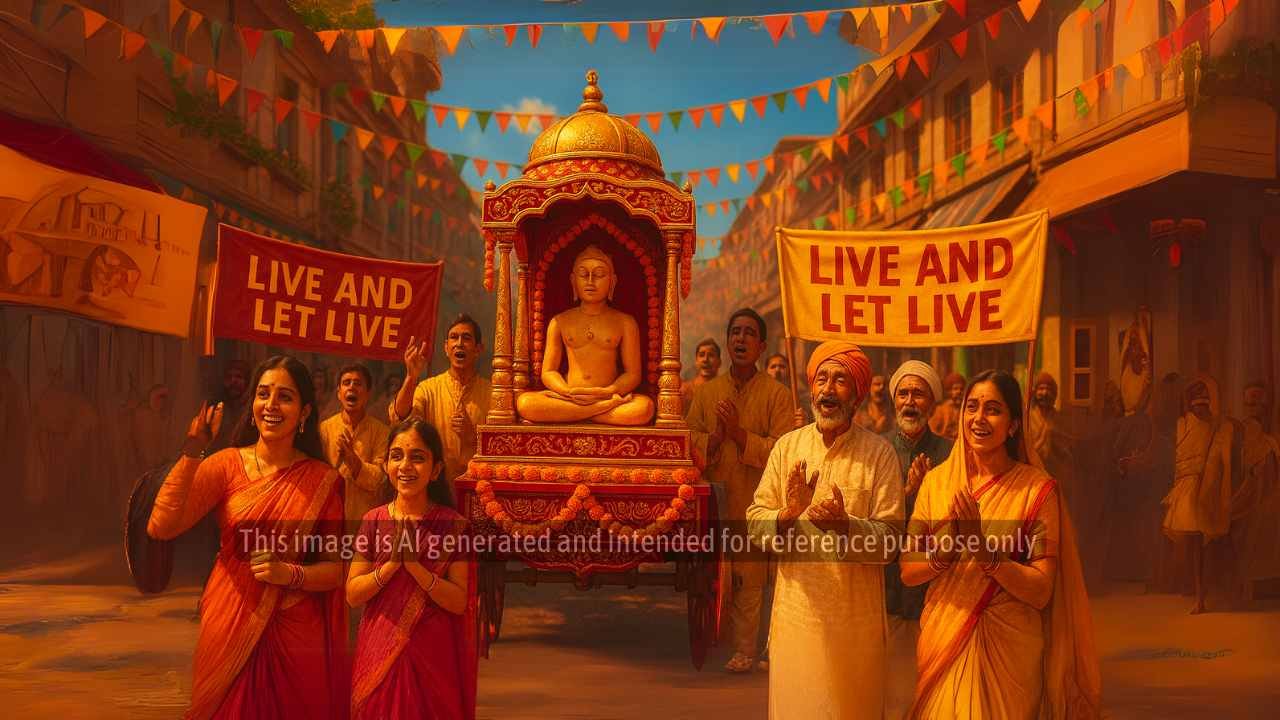
The highlight of Mahavir Jayanti is the grand procession called “Rath Yatra.” During this event, beautifully decorated chariots carry Lord Mahavira’s idol through streets while devotees sing religious songs and chant prayers. Jain temples are decorated with colorful flags and flowers, creating a festive atmosphere.
Many devotees wake up early to visit temples, where they offer prayers, perform special rituals, and listen to spiritual discourses about Lord Mahavira’s life and teachings.
2. Charitable Activities
Following Lord Mahavira’s principle of compassion, Jains engage in various charitable activities on this day. They donate food, clothes, and money to the needy and make special efforts to support causes that prevent harm to animals. Some communities organize blood donation camps and free medical checkups as a way of helping others.
3. Meditation and Fasting
Many devotees observe fasts and engage in meditation on Mahavir Jayanti, following Lord Mahavira’s example of self-discipline. Meditation centers offer special sessions to help people experience inner peace and connect with their spiritual selves.
4. Spreading Lord Mahavira’s Message
Community gatherings are organized where monks and nuns recite the teachings of Lord Mahavira and explain how they can be applied in our modern lives. These sessions often include discussions about non-violence, truth, and living with minimal possessions – principles that are increasingly relevant in today’s consumer-driven world.
Mahavir Jayanti as a Public Holiday
In India, Mahavir Jayanti is recognized as a gazetted holiday. Government offices, schools, and many businesses remain closed, especially in states with significant Jain populations like Karnataka, Rajasthan, Delhi, Haryana, Maharashtra, Uttar Pradesh, Tamil Nadu, Madhya Pradesh, and Punjab. Jain-owned businesses typically remain closed or operate with shortened hours as a mark of respect. The Bombay Stock Exchange (BSE) and the National Stock Exchange (NSE) means Share Market or Stock Market remain closed in observance of Mahavir Jayanti.
Best Places to Experience Mahavir Jayanti
If you’re interested in experiencing the true essence of Mahavir Jayanti, consider visiting these places in India:
- Palitana, Gujarat: Home to more than 900 Jain temples on Shatrunjaya Hill
- Parasnath Hill, Jharkhand: An important pilgrimage site with 24 temples
- Ranakpur, Rajasthan: Features one of the largest and most beautiful Jain temples
- Shravanabelagola, Karnataka: Famous for its monolithic statue of Bahubali
- Dilwara Temples, Mount Abu, Rajasthan: Known for their extraordinary marble carvings
These sacred places attract thousands of devotees during Mahavir Jayanti and offer a deep insight into Jain culture and traditions.
Relevance of Lord Mahavira’s Teachings Today
In our fast-paced modern world, Lord Mahavira’s teachings offer valuable guidance:
Environmental Protection
Lord Mahavira’s principle of non-violence extends to all living beings and the environment. At a time when environmental concerns are growing, his teachings remind us to live in harmony with nature and minimize harm to the planet.
Mindful Consumption
The principle of non-possession (aparigraha) encourages us to examine our consumption habits and live more simply. In an age of excessive consumerism, this teaching promotes sustainable living and conscious choices.
Inner Peace
Lord Mahavira’s emphasis on meditation and self-discipline offers tools for finding peace in our stressful lives. His teachings show that true happiness comes not from external possessions but from inner contentment.
Tolerance and Respect
In a world often divided by differences, Lord Mahavira’s message of respecting all life forms promotes tolerance and peaceful coexistence.
Conclusion
Mahavir Jayanti is not just a religious festival but a celebration of timeless values that can guide humanity toward a more peaceful and compassionate future. Whether you’re a follower of Jainism or simply someone interested in spiritual wisdom, taking a moment to understand the significance of Mahavir Jayanti can be enriching. The principles of non-violence, truthfulness, and simple living transcend religious boundaries and speak to universal human values.
As Lord Mahavira himself said, “Live and allow others to live.” This simple yet profound message continues to inspire millions around the world.
Disclaimer: This blog post is intended for informational purposes only. While every effort has been made to ensure the accuracy of the information provided, readers are advised to consult authoritative sources or religious scholars for a comprehensive understanding. The views expressed herein do not necessarily reflect those of any specific religious organization. We do not intend to hurt the sentiments of any individual, community, sect, or religion. The author and publisher disclaim any liability in connection with the use of this information.








Leave a Reply