
कृपया इसे हिंदी में पढ़ने के लिए यहाँ क्लिक करें
A New Chapter For Indian Space
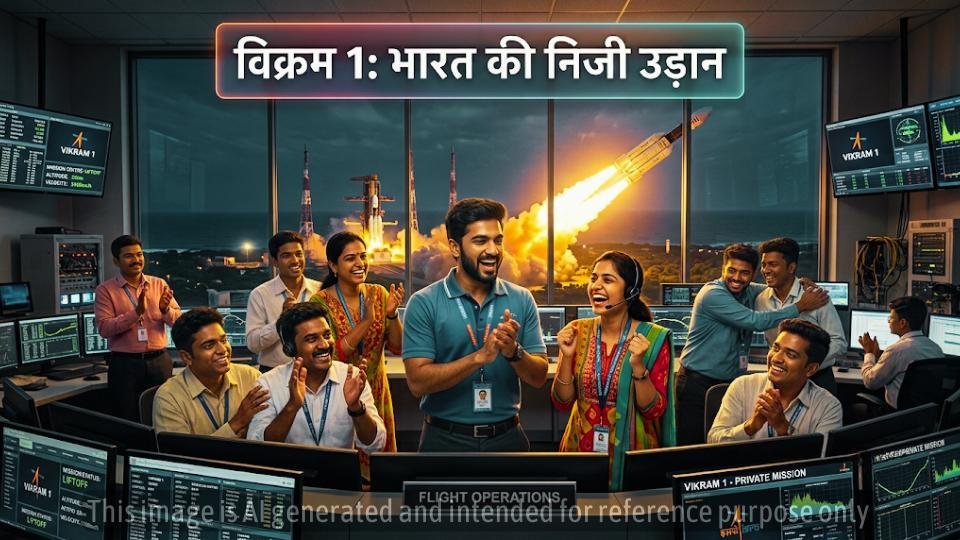
Imagine the thrill of watching a dream take flight. For decades, the Indian Space Research Organisation or ISRO has been our window to the stars. They carried the weight of a nation on their shoulders. But today, the story has changed. We are witnessing India’s SpaceX Moment. The successful launch of the Vikram 1 rocket by the private startup Skyroot Aerospace is not just a technological win. It is the beginning of a Private Rocket Era. India has now joined an exclusive club of nations where a private company can independently place payloads in orbit. It is a moment of immense pride and a sign of what is possible when ambition meets opportunity.
The Power Of The 2020 Reforms
How did we get here. The foundation was laid back in 2020 when the Indian government opened the space sector to private players. This was a massive shift. They created IN SPACe, a regulator and facilitator designed to bridge the gap between ISRO and the private industry. Before this, the private sector could build satellites or components, but they had no private Indian vehicle to actually launch them into space. The Indian Space Policy 2023 further solidified this commitment. It was like opening the floodgates. Suddenly, startups like Agnikul, Dhruva, Pixxel, Bellatrix, and Digantara found a path to growth. They all began to secure capital much more easily. The environment was ripe for a hero, and Skyroot Aerospace stepped up.
Mission Aagaman: The Sanskrit Signifier Of Arrival
The mission was named Aagaman. This is a Sanskrit word meaning arrival. It is poetic and fitting. This mission signified the arrival of the Indian private space industry on the global map. The Vikram 1 rocket lifted off from the Satish Dhawan Space Centre in Sriharikota, which is India’s main spaceport. While the liftoff faced a brief delay of 35 minutes due to a technical issue detected at the T minus 5 minute mark, the team handled it with the calm of veterans. The rocket successfully reached its planned trajectory and deployed its payloads into the Low Earth Orbit. It was a textbook launch.
The Tech Behind The Triumph
Why is Vikram 1 so special. It is a small lift orbital launch vehicle that stands roughly 20 to 24 metres tall. It is built using carbon composite structures and 3D printing technology. This makes it incredibly light and efficient. The rocket uses three solid fuel stages and one restateable liquid fuel Orbital Adjustment Module. This module allows for precise deployment into multiple orbital configurations. The stage engines are aptly named after A.P.J. Abdul Kalam. We have the Kalam 1000, Kalam 250, and Kalam 100. The fourth stage uses four Raman 1 thrusters. It is a marvel of engineering. The fact that the Skyroot team has an average age of 28 proves that the demographic dividend of India is not just a statistic. It is a powerhouse of innovation.
Looking Ahead: The Global Commercial Market
The world of space technology is changing fast. There is a global launch market worth roughly 30 billion dollars that is waiting to be tapped. Every small launch vehicle has a potential value between 30 to 50 crore rupees. India has set an ambitious goal to reach 11 billion dollars in space exports as part of a 44 billion dollar space economy by 2033. This is not just about one launch. It is about building an industry. As the founders of Skyroot Aerospace, Pawan Kumar Chandana and Naga Bharath Daka, have shown, with vision and hard work, the sky is no longer the limit. They did not just launch a rocket. They launched an industry.
A Social Message For The Dreamers
This achievement carries a simple but powerful message. It does not matter where you come from or how young you are. If you have the passion to pursue a goal that seems impossible, the world will eventually make way for you. The success of Skyroot Aerospace is a reminder that India is not just catching up with the world. We are setting the pace. Keep dreaming, keep building, and believe in the power of your own potential.
Legal Disclaimer: This article is for informational purposes only. It does not constitute financial, investment, or legal advice. News reporting on aerospace developments is based on publicly available information and current events. Please consult with professionals for any investment or legal decisions.








Leave a Reply