
कृपया इसे हिंदी में पढ़ने के लिए यहाँ क्लिक करें
The Vision Of A Connected World
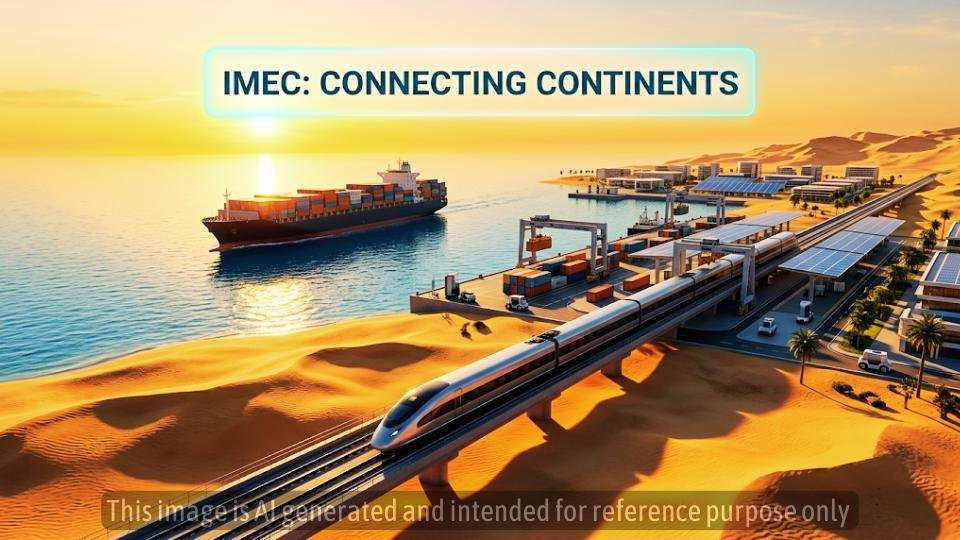
Have you ever wondered how goods travel from the bustling ports of India all the way to the historic cities of Europe. Most of the time it is a long and complex journey across the sea. Now imagine a massive project that could slash travel time and costs while completely bypassing some of the most sensitive maritime chokepoints on the planet. That is the promise of the India Middle East Europe Economic Corridor or IMEC. It is not just a bunch of roads and ports. It is a bold vision of how the future of global trade might look.
A Backstory At The G20 Summit
The idea really stepped into the global spotlight during the G20 summit held in India in September 2023. Imagine world leaders gathering around a table, debating the future, and realizing that the old ways of moving cargo were simply not efficient enough. The discussion started as a way to boost economic growth, but it quickly became clear that this was about more than just money. It was about creating a new, reliable network that connects Asia to Europe through the heart of the Middle East.
How The New Trade Route Works
The IMEC project is designed as a multimodal transport route. Think of it as a relay race for goods. It starts in India where cargo is loaded onto ships and sent across the Arabian Sea. The goods land at the Jebel Ali port in the United Arab Emirates. From there, the magic happens. The cargo is transferred to an extensive rail and road network that cuts through the desert landscape of Saudi Arabia and passes through Jordan. It reaches the Haifa port in Israel. From this point, ships take over again, carrying the goods across the Mediterranean Sea to reach major hubs in Greece, France, and Italy.
Why The World Needs This Corridor
You might ask why we need a new route when we already have the Suez Canal. The truth is that global trade is vulnerable. The Strait of Hormuz is a frequent point of geopolitical tension. If that area becomes unstable, trade suffers. The IMEC corridor offers a massive strategic advantage by creating an alternative path. By integrating shipping, rail, and road, this project aims to make the movement of goods faster, cheaper, and far more secure than current maritime routes.
The Rivalry With China And The Belt And Road Initiative
We have to talk about the elephant in the room, which is the Belt and Road Initiative or BRI pushed by China. For years, China has been building infrastructure across the world to dominate trade routes. The IMEC corridor is viewed by many analysts as a direct strategic response. While the BRI focuses heavily on Chinese interests, the IMEC project relies on a coalition of nations. It is a way for India and its partners to establish a presence that is not dependent on a single country. It is a classic move in the global chess game of geopolitics.
The Roadblocks And Future Challenges
This project sounds incredible on paper, but turning it into reality is a different story. The Middle East is a region defined by complex political dynamics. Ongoing conflicts and regional tensions pose a real threat to the construction and long term stability of such a massive project. Furthermore, the sheer scale of the construction requires immense cooperation between countries that do not always see eye to eye. It will take years of diplomatic effort and heavy investment to make this a functional, everyday reality.
A Message Of Global Unity
At the end of the day, projects like IMEC remind us that the world functions best when we are connected. We are living in an era where economies are deeply intertwined. When we build bridges instead of walls, and when we create routes that foster cooperation rather than conflict, everyone wins. The goal should always be to uplift communities, create jobs, and ensure that prosperity flows as easily as the goods that fuel our lives. Let us hope that the vision of unity drives these nations forward to build a brighter, more connected tomorrow.
Legal Disclaimer: This article provides information based on general news reports and analysis. It is for educational purposes only. Geopolitical situations are fluid and subject to change rapidly. Readers should consult official government sources and verified international news outlets for the most current updates and official policy statements regarding the IMEC project.





Leave a Reply