
कृपया इसे हिंदी में पढ़ने के लिए यहाँ क्लिक करें
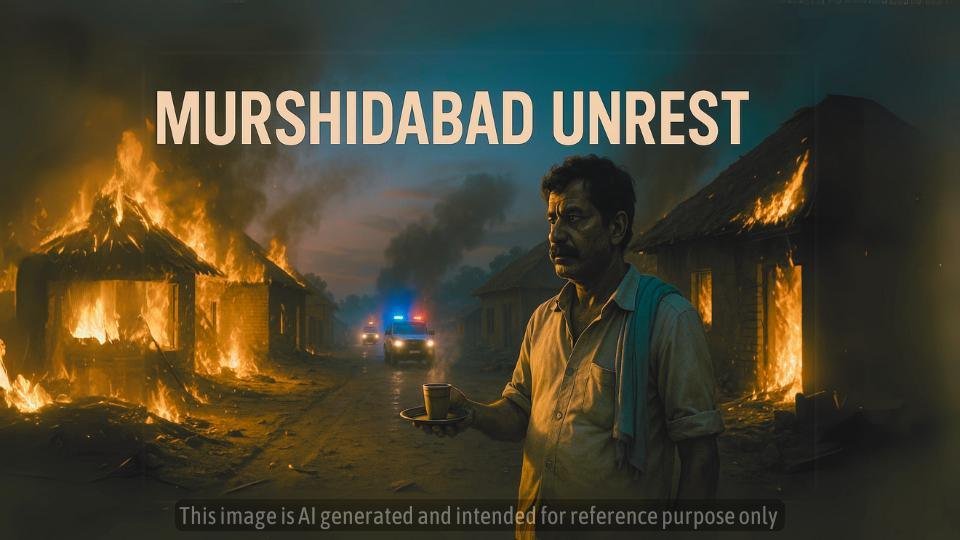
A three-member fact-finding committee appointed by the Calcutta High Court concluded that the mob violence in Murshidabad on April 11–12 specifically targeted Hindu residents, while local police remained completely inactive and absent during the critical hours of the attack. The report further alleges that local Trinamool Congress councillor Mehboob Alam orchestrated the violence under the guise of protests against the Waqf (Amendment) Bill, 2025. The unrest resulted in three confirmed fatalities—including a father and son—over ten injuries, and forced more than 400 Hindu families to flee their homes, seeking shelter across the Bhagirathi River in Malda district. Political fallout has intensified, with the BJP accusing the Mamata Banerjee-led TMC government of communal bias and negligence, while the TMC has decried the politicization of the tragedy. In response, a Special Investigation Team has been constituted and the Calcutta High Court has directed both state and central forces to ensure the safety of all communities and hold those responsible to account.
Background: Waqf Amendment Bill and Local Tensions
The Waqf (Amendment) Act, 2025
The Waqf (Amendment) Act, 2025, passed by the Indian Parliament in March, aimed to streamline administration and transfer of certain Waqf properties but was met with protests in West Bengal, where objections centered on fears of land redistribution affecting minority communities. Opposition leaders claimed the law threatened local autonomy over religious endowments, fueling demonstrations that spread across Murshidabad district by early April.
Rising Communal Strains
Social media posts labeling the bill as an attack on minority rights heightened communal anxieties, particularly in Betbona, Dhulian, Suti, and Shamsherganj blocks, where both Hindu and Muslim communities have coexisted for generations. Local Telegram groups circulated calls for “protest marches,” which, according to the committee report, were commandeered by violent elements seeking to target Hindu households under the veneer of lawful protest.
The Incident: April 11–12 Violence in Murshidabad
Sequence of Events
On April 11 at approximately 2:30 PM, a mob led by local councillor Mehboob Alam converged on Betbona village, systematically looting shops and setting fire to homes identified as belonging to Hindu families. Eyewitnesses reported that attackers marked Hindu houses, broke down doors with crowbars, and hurled stones and petrol bombs, forcing residents to flee in panic. The violence spread overnight to neighbouring Dhulian, where crowds torched two temples and vandalized a community centre before subduing attempts by residents to defend their properties.
Human Cost
Three people were killed in the attacks: father-son duo Sanjay Roy (45) and Arindam Roy (18), and 17-year-old Izaz Ahmed Sheikh, who was shot during clashes. Dozens more suffered injuries ranging from gunshot wounds to burns, including elderly women who jumped from second-floor windows to escape the flames. Over 400 displaced Hindus crossed the Bhagirathi River to Malda district, where schools were converted into makeshift relief camps under the supervision of district authorities.
Police Inaction and Response
Fact-Finding Report Findings
The High Court-appointed committee reprimanded local police for their “complete inactivity and absence” during the violence, noting that multiple distress calls went unanswered as officers remained stationed miles away in the sub-divisional headquarters. CCTV footage reviewed by the panel showed officers abandoning patrol vehicles shortly before the attacks and not returning until the violence had subsided.
Administrative Measures
Following the violence, the state government imposed Section 144 of the Criminal Procedure Code in affected areas, suspended internet services to curb rumors, and deployed additional central paramilitary forces alongside local units to restore order. A nine-member Special Investigation Team (SIT) has been set up by the West Bengal Police to investigate the incidents and expedite legal proceedings against the perpetrators.
Political Reactions and Accusations
BJP’s Allegations
The Bharatiya Janata Party has labeled the incident as “anti-Hindu brutality,” demanding immediate action against implicated TMC leaders and calling for Governor’s Rule in the state to ensure impartial inquiry. Union Home Minister was reported to have been briefed on the situation, and the BJP has threatened to escalate the matter to the Supreme Court if accountability is not forthcoming.
TMC’s Defence
The Trinamool Congress has accused the BJP of politicizing a tragedy, asserting that fringe elements instigated the violence to destabilize communal harmony \. Chief Minister Mamata Banerjee condemned the attacks, appealed for peace across all communities, and emphasized that the state would not implement the Waqf Amendment Act until consensus was reached.
Ground-Level Accounts and Anecdotes
Courage Amid Chaos
Despite the onslaught, several Hindu families formed human chains to protect their neighbours’ homes, sharing food and water with fleeing Muslim neighbours caught off-guard by the violence. In one lighter moment amid horror, villagers recalled how Suresh Patel, a local tea-seller, offered free cups of masala chai to all who gathered on the banks of the Bhagirathi, joking that “even rioters need a break and a good chai” before continuing their march.
Community Solidarity
Local NGOs and Muslim community leaders organized relief convoys, providing blankets and medicines to displaced Hindu families in makeshift camps, demonstrating that grassroots solidarity endured despite the orchestrated violence.
Aftermath and Ongoing Investigation
Judicial Oversight
The Calcutta High Court has requested fortnightly updates from the SIT and state government on arrests and prosecutions, warning of contempt proceedings if deadlines are missed. Over 300 individuals have been arrested so far, with at least 60 FIRs lodged covering charges from rioting and arson to attempt to murder.
Road to Reconciliation
District magistrates in Murshidabad have initiated “peace committees” comprising local elders, panchayat members, and youth leaders to facilitate dialogue between Hindu and Muslim residents, aiming to rebuild trust and ensure long-term communal harmony.
Known and Lesser-Known Facts
- The violence disrupted train services at Nimtita station for 48 hours, stranding daily commuters and merchants.
- A total of 10 injuries were officially recorded by the health department, although local clinics reported treating an additional 15 unregistered cases.
- The total value of damaged property, including homes, shops, and temples, is estimated at over ₹5 crore, according to initial government surveys.








Leave a Reply