
कृपया इसे हिंदी में पढ़ने के लिए यहाँ क्लिक करें
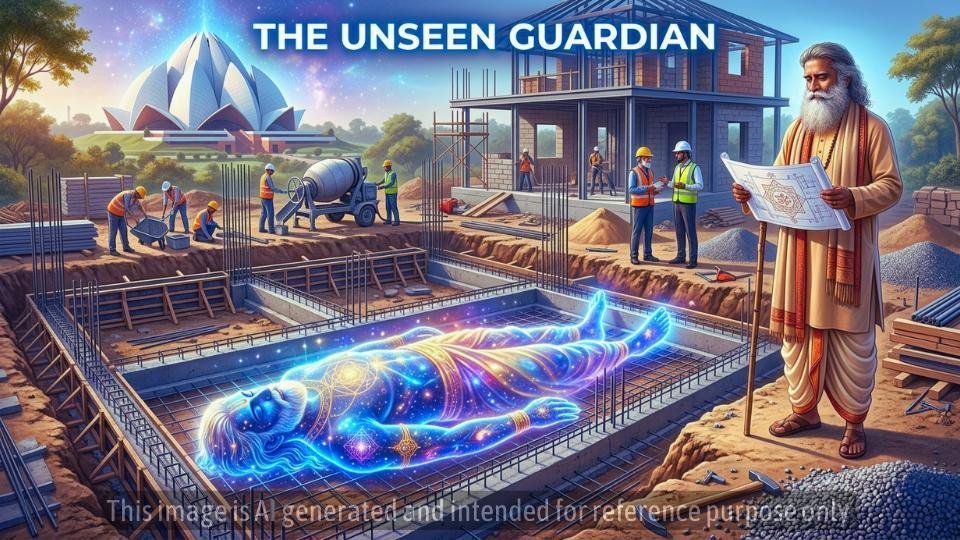
Every home has an invisible guardian, a cosmic entity that resides within its very foundation, influencing the harmony and prosperity of its inhabitants. This entity is known as Vastu Purush, the soul of Vastu Shastra, the ancient Indian science of architecture. This is the story of his creation and why his blessings are sought before any construction begins.
A Backstory Forged in Cosmic Battle
The tale of Vastu Purush begins with a fierce battle between Lord Shiva and the formidable demon, Andhakasura. The celestial conflict was so intense that the universe trembled. In the heat of this battle, a single drop of Lord Shiva’s sweat fell to the earth. From this drop, a colossal, fearsome being was born. This creature grew at an astonishing rate, its hunger and power seemingly without limits, threatening to devour all of creation.
Fearing the destruction of the cosmos, the gods sought the counsel of Lord Brahma, the creator. Brahma advised the celestial beings to overpower the giant. Together, they pinned the creature to the ground. Trapped, the being cried out to Brahma, questioning his fate as he was a product of creation itself. Filled with compassion, Brahma offered him a boon. He named the entity “Vastu Purush” and declared that he would be the resident spirit of every piece of land and dwelling. It was decreed that anyone who constructed a building must first offer prayers to Vastu Purush. Those who honored him would be blessed with peace, prosperity, and happiness.
The Science and Spirit of Vastu Shastra
Vastu Shastra is founded on the principle of harmonizing the five elements—Earth, Water, Fire, Air, and Space—within a structure. The Vastu Purush Mandala, a sacred geometrical diagram, represents the cosmic man, with his head in the northeast and his feet in the southwest. This blueprint guides the placement of different rooms in a house to ensure a balanced flow of energy.
For example, the kitchen, associated with the element of fire, is ideally placed in the southeast. The prayer room, a space for spiritual clarity, is best located in the northeast, which corresponds to the head of Vastu Purush. By adhering to these principles, a home can become a sanctuary of positive vibrations, fostering the well-being of its occupants.
A Social Message: Building with Respect
The story of Vastu Purush imparts a profound social message: our homes are not merely bricks and mortar; they are living, breathing spaces with their own energy. The tradition of Vastu Puja teaches us to approach the act of building with reverence and respect for the environment and the unseen energies that surround us. By seeking the blessings of Vastu Purush, we acknowledge our interconnectedness with the universe and build a foundation of harmony not just for our homes, but for our lives.
The ritual reminds us to be mindful of the impact of our actions on the world around us. In an era of rapid urbanization and environmental challenges, this ancient wisdom encourages us to build in a way that is sustainable, respectful, and in tune with nature. By creating homes that are balanced and harmonious, we contribute to a more peaceful and positive world for everyone.
Disclaimer: This article is intended for informational and educational purposes only. The Vastu Shastra principles and the story of Vastu Purush are based on ancient Indian texts and beliefs. The information provided is not intended to be a substitute for professional advice. The author and publisher do not claim any responsibility for any outcomes, positive or negative, that may arise from following the suggestions in this article. Readers are encouraged to use their own discretion and consult with a qualified Vastu expert for personalized guidance. The effectiveness of Vastu Shastra and its practices is a matter of personal faith and belief.





Leave a Reply