
कृपया इसे हिंदी में पढ़ने के लिए यहाँ क्लिक करें
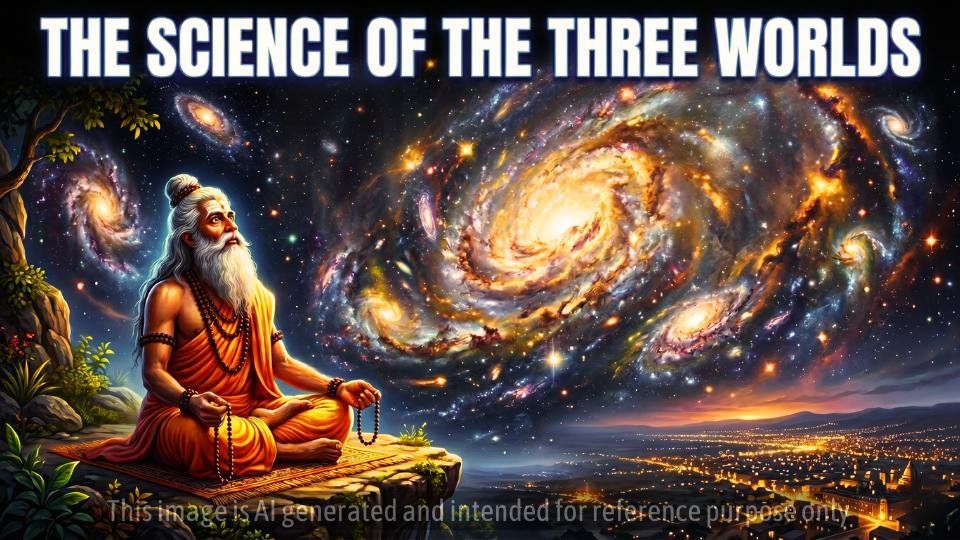
Hello, and welcome to our corner of the internet, where we explore the deepest questions of life and the cosmos. Today, we’re diving into a topic that has fascinated thinkers for millennia: the concept of the ‘Three Worlds’ or Trilok. But what if I told you that ‘three’ is just the beginning of a reality so vast it can shatter our understanding of existence?
Drawing inspiration from the profound wisdom of spiritual masters like Premanand Ji Maharaj, we will embark on a journey through these cosmic planes, connecting ancient knowledge with the grand scale of the universe.
The Tip of the Iceberg: What are the Three Worlds?
In simple terms, Sanatana Dharma (Hinduism) often speaks of the Trilok:
- Swarga Loka (Heavenly Realm): The abode of gods (Devas), filled with celestial pleasures.
- Prithvi Loka (Earthly Realm): The mortal world where we live, a plane of action (Karma).
- Patala Loka (Netherworld): The realms beneath the Earth, inhabited by various mystical beings.
But hold on, this is where the story gets truly mind-bending. According to saints and scriptures, this is just one tiny corner of a much larger picture.
A Lesson in Humility: The Story of Our Brahma
There’s a fascinating story told in the Garga Samhita. Once, Lord Brahma, the creator of our universe with his four faces, went to meet Lord Krishna. When he arrived, a celestial attendant asked, “Which Brahma are you? Please state your purpose.”
Brahma was stunned. Which Brahma? He thought he was the only one.
Just then, he witnessed an astonishing sight. A countless parade of other Brahmas began to arrive. Some had ten faces, some a hundred, some a thousand, and others had millions! They were the creators of countless other universes. In that moment, our four-faced Brahma realized his own place in the grand, infinite creation. He was but one creator among an ocean of creators.
This story teaches us a profound lesson about humility. No matter how much we achieve or know, we are but a tiny speck in the infinite cosmic dance.
Innumerable Universes in a Single Pore
The ancient texts take this concept even further. It is said that the countless universes (Brahmandas) we’ve just discussed exist within the pores of the skin of Maha Vishnu, the Supreme Being. Can you imagine? An entire universe, with its billions of galaxies, stars, and planets, fitting into a space smaller than a mustard seed on a cosmic scale. Our human intellect simply cannot fathom this immensity. There are countless Narayanas, countless Shivas, and countless Devas, each presiding over their own universal domain.
A Word of Caution: Do Not Imitate the Divine
Sometimes, people misunderstand divine actions and try to imitate them, leading to their own ruin. A humorous yet profound story illustrates this. When asked why people shouldn’t consume intoxicants when Lord Shiva does, the answer is simple: can you do what Lord Shiva does?
- He Drank Cosmic Poison: During the great churning of the ocean (Samudra Manthan), a deadly poison called Halahal emerged that could destroy all creation. To save everyone, Lord Shiva calmly drank it, holding it in his throat, which turned blue (hence his name, Neelkanth).
- He Holds the Mighty Ganga: The celestial river Ganga descended with such force that it could have shattered the Earth. Lord Shiva caught the entire river in his matted locks to soften her descent. Could a human hold even a bucket of water on their head like that?
- His Adornments are Deadly: He wears Vasuki, the king of snakes, as a necklace. A cobra adorns him. His sacred thread is a serpent.
His divine family is another marvel. His consort Parvati’s mount is a lion. His own is Nandi, the bull (a lion’s natural prey). His son Ganesha’s mount is a mouse, and his other son Kartikeya’s mount is a peacock. Both the peacock and Shiva’s serpents are natural enemies of the mouse. Yet, they all live in perfect harmony. This is the power of the divine.
To try and copy a divine being’s actions without possessing their divine power is the height of foolishness. Their actions are for cosmic welfare; our actions should be guided by discipline and righteousness.
Our Fleeting Moment in Cosmic Time
The scale of Hindu cosmology is staggering. In a single day of Brahma (one Kalpa), 14 rulers known as Manus change. A single lifespan of Brahma is 100 of his years, after which a Maha-Pralaya (great dissolution) occurs. Even this entire cycle is but a blink of an eye for the Supreme Lord.
So, where do we fit in? Our life of 70, 80, or even 100 years is less than a second in this cosmic clock. Knowing this should make us think: how are we spending this precious, fleeting moment?
A Social Message: Find Your True Purpose
This cosmic knowledge isn’t meant to make us feel insignificant, but to help us see beyond our petty ego and worldly attachments. We get caught up in small disputes, temporary successes, and fleeting sorrows, all while being a part of this unbelievably grand design.
The real message is to turn inward. Instead of trying to conquer the world, let’s try to conquer our own minds. Instead of accumulating temporary wealth, let’s accumulate the eternal wealth of devotion, kindness, and love. Our life’s true purpose isn’t just to exist in this cycle but to break free from it by connecting with the Supreme Source of all these universes—God.
Disclaimer: The information presented in this article is for educational and spiritual exploration purposes only. The content is based on teachings, interpretations of ancient scriptures, and philosophical concepts within Sanatana Dharma. It is not intended to be a substitute for professional, scientific, or historical advice. The views expressed herein are a synthesis of spiritual discourses and scriptural interpretations and should be approached with an open and reflective mind. The reader is solely responsible for their own interpretation and application of this information.




Leave a Reply