
कृपया इसे हिंदी में पढ़ने के लिए यहाँ क्लिक करें
In a move that is set to redefine the concepts of privacy and citizenship in the digital age, the Government of India is quietly rolling out a powerful, AI-driven surveillance architecture. This system, a culmination of years of data collection and technological integration, is creating a new reality for the nation’s 1.4 billion people, where every digital footprint can be traced, analyzed, and verified. At the heart of this transformation is “Operation Gandiv,” an AI librarian that sifts through a colossal sea of data, leaving many to wonder if we are witnessing the end of the anonymous Indian.
The Backstory: From Protests to a Silent Digital Revolution
Not too long ago, the nation was rocked by widespread protests against the proposed Citizenship Amendment Act (CAA) and a nationwide National Register of Citizens (NRC). The streets echoed with the slogan, “Hum kaagaz nahi dikhayenge” (We will not show our papers). The government, faced with public opposition, seemingly put the brakes on the initiative.
However, the ambition of creating a verifiable database of citizens did not disappear. Instead, it metamorphosed into a quieter, more technologically advanced form. Through the Election Commission’s Special Intensive Revision (SIR), a massive voter card verification process was initiated. While a voter ID is not proof of citizenship, it is a document that only a citizen can possess, creating an indirect but crucial link to one’s national identity. This move was the first step in a much larger plan.
The Core Components: NATGRID, NPR, and the AI Brain “Gandiv”
At the center of this new surveillance infrastructure are two key elements: the National Intelligence Grid (NATGRID) and the National Population Register (NPR). Conceived after the 2008 Mumbai attacks, NATGRID is designed to be an integrated intelligence master database, connecting information from 21 different government organizations. This includes everything from banking and travel records to telecommunication data.
The game-changer, however, has been the recent integration of the NPR with NATGRID. The NPR contains demographic and family-level details of nearly 119 crore residents. This linkage allows security agencies not just to access an individual’s data but also to map out their entire family tree and residential history.
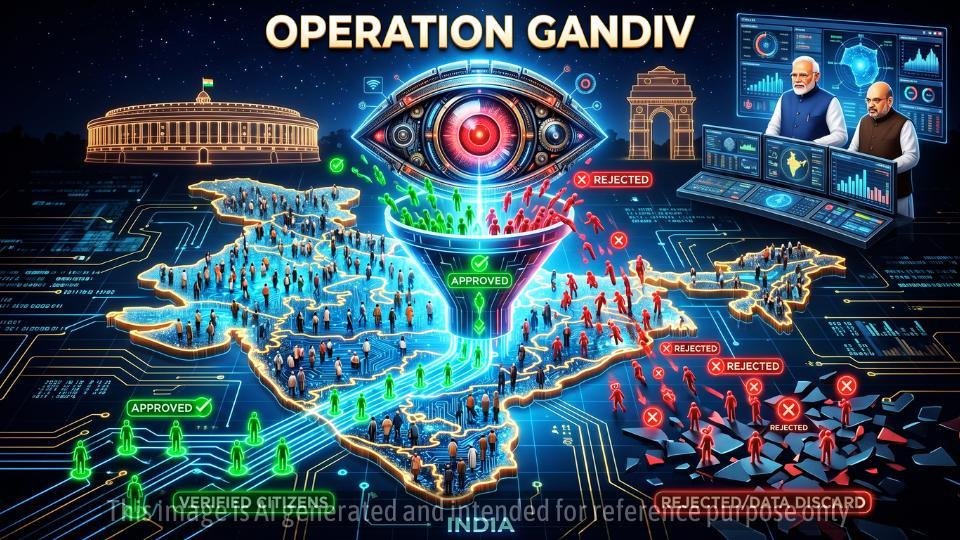
The “brain” that processes this immense volume of information is an AI-powered tool named Operation Gandiv. Named after the celestial bow of the warrior Arjuna from the Mahabharata, this AI system acts as a sophisticated “librarian,” capable of cross-referencing datasets at lightning speed. It can analyze patterns, detect anomalies in your data, and flag individuals who do not fit a “clean” digital profile.
The Mystery of the 21 Crore “Missing” Indians
According to the government’s own data, out of a population of over 140 crore, only 119 crore are “verified digital residents.” This leaves a staggering 21 crore people unaccounted for in the digital realm. These are individuals who, for various reasons, may have discrepancies in their data or lack a complete digital footprint.
This is where the power of Operation Gandiv becomes apparent. The AI isn’t just looking for criminals; it is looking for anyone who is digitally “invisible” or “unverifiable.” This has raised serious concerns about the potential for digital exclusion on a massive scale.
The Filter: Who Is at Risk?
The system employs a multi-layered filtering process to identify these “unverifiable” individuals:
- Digital Forensics: The AI scans for inconsistencies in metadata. For instance, if your mobile SIM card is registered in someone else’s name or your Aadhaar details haven’t been updated in years, you could be flagged.
- Genealogical Gaps: With access to the NPR, Gandiv can construct a “digital family tree.” If there are missing links or discrepancies in your family’s records, the entire family could be placed on a “grey list.”
- The Invisibility Trap: A significant portion of India’s population, including the poor, the elderly, tribal communities, and nomadic groups, have a limited digital presence. These marginalized communities are at the highest risk of being filtered out and potentially becoming “digital refugees” in their own country.
A Social Message: The Price of Security
In our quest for national security, we stand at a crossroads. The promise of technology to protect us from harm is immense, but so is its potential to create new forms of exclusion and control. A system that can identify a terrorist can also misidentify an innocent citizen.
The true strength of a nation lies not just in its security but in its ability to protect the rights and dignity of every single individual, especially the most vulnerable. As we move towards a future of algorithmic governance, it is our collective responsibility to ensure that technology serves humanity, and not the other way around. We must find a balance where security does not come at the cost of our fundamental freedoms, and where every Indian, regardless of their digital footprint, has a place in the nation’s future.








Leave a Reply