
कृपया इसे हिंदी में पढ़ने के लिए यहाँ क्लिक करें
The Essence of the Pandharpur Wari
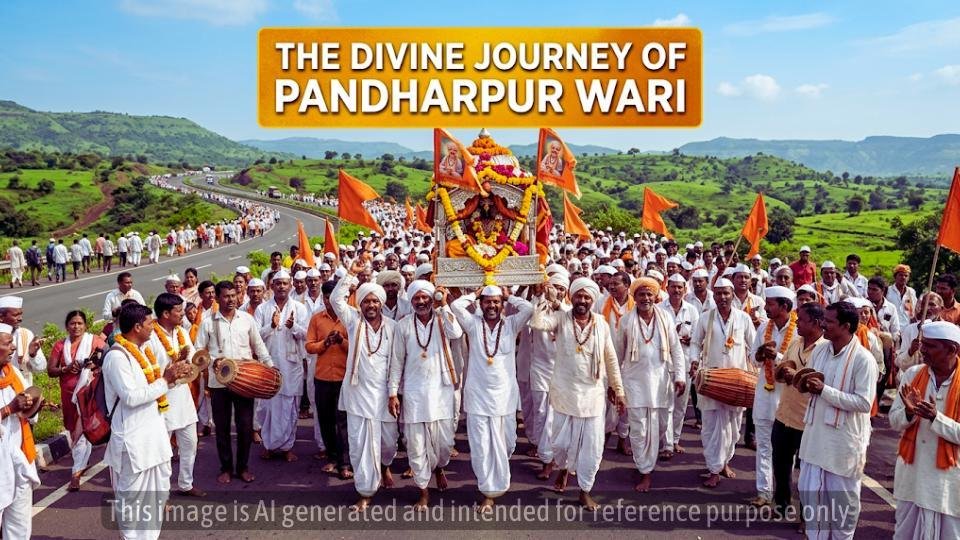
If you have been scrolling through social media lately, you have surely seen the sea of white and saffron flooding the roads of Maharashtra. You might wonder what this massive movement of people is all about. This is the Pandharpur Wari, an annual spiritual pilgrimage that is far more than just a religious event. It is a profound cultural phenomenon that brings millions of people together in a display of faith, endurance, and unmatched unity.
The Pandharpur Wari involves thousands of devotees, known as Warkaris, walking on foot from places like Alandi and Dehu all the way to Pandharpur. This journey spans roughly 250 to 300 kilometers and takes about 21 days to complete. It is a trek across the Maharashtra landscape where age, gender, and social status dissolve into a singular purpose.
The Backstory of Lord Vitthal and the Brick
To understand why this pilgrimage exists, you must look at the legend of Lord Vitthal and his devotee Pundalik. The story tells of Pundalik, who was so devoted to serving his elderly parents that when Lord Krishna visited him, he threw a brick, or a Veet, toward the Lord and asked Him to wait. He told the Lord that his service to his parents came first. Lord Vitthal graciously stood on that brick, waiting for Pundalik to finish his duties. That is why the deity at Pandharpur is depicted standing on a brick. It is a powerful symbol of dedication and humility that grounds the entire Wari tradition.
The First Warkari: The Legend of Lord Shiva
While the Warkaris are the human face of this journey, ancient lore suggests that Lord Shiva himself was the first to walk this path. Legend has it that when Mahadev learned that the Supreme Lord was waiting on a brick in the mortal realm, he was overwhelmed with emotion. He abandoned Mount Kailash and walked to Pandharpur to see the Lord for himself. This legend adds a mystical layer to the pilgrimage, reminding everyone that even the divine participates in this journey of devotion.
A Powerful Message of Equality
The most beautiful part of the Pandharpur Wari is the radical equality it promotes. In this crowd of millions, you will see a wealthy business owner and a struggling farmer walking side by side. They share the same road, the same meals, and the same struggles. When they meet, they bow to each other and say Mauli, acknowledging that the divine resides in every single person. In the Wari, labels do not exist. There is no class, no caste, and no hierarchy. Everyone is simply a pilgrim seeking connection.
Modern Management and Community Care
It is truly impressive to see how such a massive gathering functions without any major issues. The modern Pandharpur Wari is a masterclass in community management. The Pune Police and thousands of volunteers work tirelessly around the clock to manage traffic and ensure the safety of the pilgrims. Local residents also play a huge role, setting up stalls to provide food and water as an act of selfless service. It is a seamless operation where the infrastructure is built on kindness rather than just rigid rules.
A Message of Empathy for Today
In a world that is often divided by opinions and differences, the Pandharpur Wari stands as a glowing example of what humans can achieve when we choose love over ego. It teaches us that we do not need intermediaries to reach the divine or to reach each other. True spirituality is found in the simple act of walking together and recognizing the humanity in every face you pass. Let us learn from the Warkaris to treat everyone we meet with the respect due to a Mauli.
Standard Legal Disclaimer: The information provided in this article is based on cultural traditions, historical legends, and general news reporting. It is intended for informational and educational purposes only. Any views or interpretations expressed are those of the author and do not constitute professional advice or objective news reporting. Please verify specific historical details through academic or religious texts if you require absolute historical accuracy.








Leave a Reply