
कृपया इसे हिंदी में पढ़ने के लिए यहाँ क्लिक करें
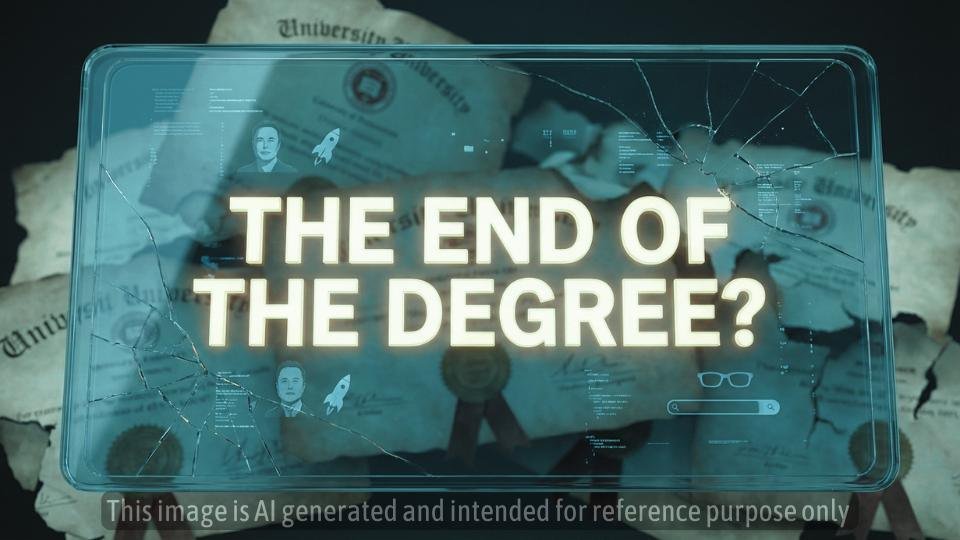
Your college degree, the one you and your parents sacrificed so much for, is rapidly losing its value in the global job market. A silent revolution is underway, and a piece of paper is no longer the golden ticket to a secure future.
This isn’t just a headline; it’s a reality unfolding across the globe. Big tech companies like Google, Apple, IBM, and Accenture are leading the charge, making it clear that they’re more interested in what you can do than where you went to college. In a bold move, these giants have even started to eliminate degree requirements for many of their positions.
This seismic shift is a direct response to a glaring problem: the growing gap between what colleges teach and what industries need. The 2025 Jobs Report from the World Economic Forum reveals that 30% of Indian employers plan to switch to skills-based hiring, a significant increase from the global average of 19%.
The Indian Education Paradox
While the world moves forward, India’s education system seems to be stuck in the past. We’re churning out graduates with degrees that are increasingly irrelevant in the real world. A shocking 75% of Indian colleges are failing to produce job-ready graduates. Here’s a look at the grim statistics:
- 65% of graduates are unemployed, including those with engineering and MBA degrees.
- 47% of engineering graduates are unfit for jobs in their field.
This isn’t just an unemployment crisis; it’s a systemic failure. We’re teaching a 20th-century syllabus to 21st-century students, expecting them to solve 22nd-century problems.
The result? A generation of young people armed with degrees but lacking the skills to succeed. While your degree might get you an entry ticket, it’s your skills that will keep you in the game.
A Social Message: The Future Is in Your Hands
To the youth of India, I say this: do not be discouraged. The end of the degree era is not the end of opportunity. It’s a new beginning.
Your future is not defined by a piece of paper but by your ability to learn, adapt, and solve problems. Don’t just chase degrees; chase skills. Build a portfolio of real-world projects, contribute to open-source, and never stop learning. The new job market is a meritocracy where your abilities are your currency.
Key Figures Leading the Change
The shift to skills-based hiring is being championed by some of the most influential figures in the tech world. Google co-founder Sergey Brin has openly stated that Google has hired many individuals without college degrees who have proven their capabilities. Similarly, Apple CEO Tim Cook has emphasized that problem-solving abilities are far more valuable than formal qualifications. In India, companies like Zerodha and Tata Communications are also embracing this new philosophy, recognizing that curiosity and a willingness to learn are more important than a long list of academic credentials.
Unknown Facts and Humorous Anecdotes
Did you know that many of the most successful people in the world never finished college? From Bill Gates and Steve Jobs to Mark Zuckerberg, these individuals prove that passion and skill can take you further than any degree.
Here’s a humorous take: imagine a world where your LinkedIn profile is more important than your college transcript. A world where your GitHub repository speaks louder than your GPA. That’s the world we’re heading towards, so you better start working on your online presence!
In-Depth Analysis and the Path Forward
So, what does this all mean for the future of education and employment in India? It’s a wake-up call for our entire education system. We need to:
- Overhaul our outdated curriculum to align with industry needs.
- Focus on practical, hands-on learning instead of rote memorization.
- Integrate real-world projects and internships into our education system.
- Encourage a culture of lifelong learning and skill development.
As individuals, we need to take control of our own learning. We need to become proactive, adaptable, and constantly seek new knowledge and skills.
Disclaimer: This article is for informational purposes only and does not constitute professional advice. The information provided is based on publicly available data and reports, and the author and publisher are not responsible for any inaccuracies or omissions.




Leave a Reply