
कृपया इसे हिंदी में पढ़ने के लिए यहाँ क्लिक करें
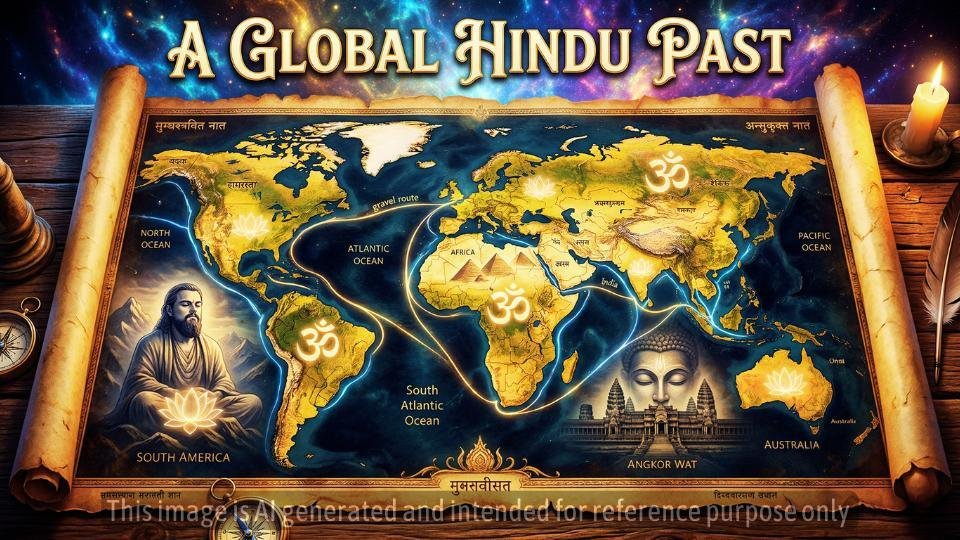
Good evening, and welcome to our global news desk. Tonight, we delve into a story that stretches back not just centuries, but millennia. We’re peeling back the layers of time to explore a fascinating question: Was there a time when the principles and culture of what we now call Hinduism were a global phenomenon? The evidence, scattered across continents and buried under the sands of time, is compelling and paints a picture of a deeply interconnected ancient world.
A World Before Borders: The Story Begins
It’s easy to think of Hinduism as a religion confined to India, but the historical and archaeological records tell a different story. In an era when merchants, monks, and explorers traveled with ideas as their most precious cargo, the spiritual philosophies of Sanatana Dharma (the eternal way of life) flowed freely across land and sea.
From Mexico to the Mediterranean: The Trail of Evidence
Let’s travel to Mexico, a land thousands of miles from the Indian subcontinent. During a routine excavation, archaeologists unearthed ancient sculptures of deities that were unmistakably Lord Ganesha and Goddess Lakshmi. But the connections don’t stop there. Some scholars suggest that the word ‘Mexico’ itself might have roots in the Sanskrit word ‘Makshika’. This discovery opens up a world of questions about ancient trade routes and cultural exchanges that we are only now beginning to understand.
Further east, in Southeast Asia, the influence is undeniable. The magnificent temple complex of Angkor Wat in Cambodia, the largest religious monument in the world, was originally built as a Hindu temple dedicated to Lord Vishnu. Similarly, the stunning Prambanan Temple in Indonesia is a 9th-century Hindu marvel. For centuries, Hinduism and Buddhism co-existed and flourished in this region, leaving behind a legacy of art, architecture, and culture that continues to inspire awe.
Our journey doesn’t end there. Did you know that in a vault in Russia, an ancient idol of Lord Vishnu was discovered? Or that remnants of a 6,000-year-old Shiva temple were found in Africa? These are not isolated incidents. Evidence of a Hindu past, from ancient scripts to temples, has been found in countries like China, Malaysia, Japan, Laos, and even as far as Iran. In fact, it is said that Arjuna, one of the great heroes of the epic Mahabharata, married a princess from a land that geographically aligns with modern-day Mexico.
How Did It Spread? A Tale of Trade, Travel, and Tolerance
Unlike many other faiths, the global spread of Hinduism wasn’t about conquest. It was a story of organic cultural diffusion. For millennia, sailors and traders from the Indian subcontinent were masters of the sea. They established bustling trade routes that connected them with distant lands. As they traded spices, textiles, and precious metals, they also shared their philosophies, stories, and ways of life. This gentle exchange of ideas is what allowed Hindu and Buddhist traditions to be warmly received in many parts of the world.
Later, during the colonial era, a different kind of migration took place. Indentured laborers from India were taken to British and Dutch colonies in the Caribbean, Fiji, Mauritius, and parts of Africa. These resilient communities held on to their faith and traditions, planting the seeds of Hinduism in new lands. Today, countries like Mauritius and Trinidad & Tobago have significant Hindu populations and have even had Hindu heads of state.
A Social Message for Our Times
In a world often divided by differences, the ancient story of Hinduism’s spread offers a powerful and gentle lesson. It teaches us that culture can be shared without conflict and that ideas can travel across the globe, enriching everyone they touch. It’s a message of tolerance, coexistence, and the beautiful tapestry of human connection. The fact that Hinduism and Buddhism peacefully coexisted for centuries in Southeast Asia is a testament to this spirit. This history reminds us that our interconnectedness is not a new phenomenon but an ancient truth.
Back to the Present
Today, Hinduism is the world’s third-largest religion, with over a billion followers. While the vast majority live in India, vibrant Hindu communities thrive on every continent, a modern echo of an ancient global presence. From the temples of Bali in Indonesia to the yoga studios of California, the timeless principles of Sanatana Dharma continue to resonate with people from all walks of life. This enduring legacy is a reminder that the human search for meaning, purpose, and inner peace knows no borders.







Leave a Reply