
कृपया इसे हिंदी में पढ़ने के लिए यहाँ क्लिक करें
Welcome, readers, to a story that is not just about food, but about life itself. Today, we journey into the sun-baked fields of Maharashtra, to uncover the tale of a condiment so powerful, a small spoonful is enough to awaken the senses. We’re talking about Thecha, the fiery, rustic, and beloved chutney that has now found its way into kitchens across the world. But this was not born in a fancy restaurant; its story began with the sweat and toil of a farmer and a very simple meal.
A Backstory of Simplicity and Need
Imagine a farmer in rural Maharashtra, perhaps in the regions of Vidarbha or Marathwada, working tirelessly under the hot sun all day. His lunch is simple and practical: a dry, hardy flatbread called bhakri (made from sorghum or millet) and a raw onion. While this meal provides energy, it can feel monotonous and incomplete. The farmers needed something small, cheap, quick to make, and powerful enough to cut through the dryness and add a spark to their food. They needed a taste that was “jhanjhanit” – a Marathi word that perfectly captures a thrilling, electrifying sensation.
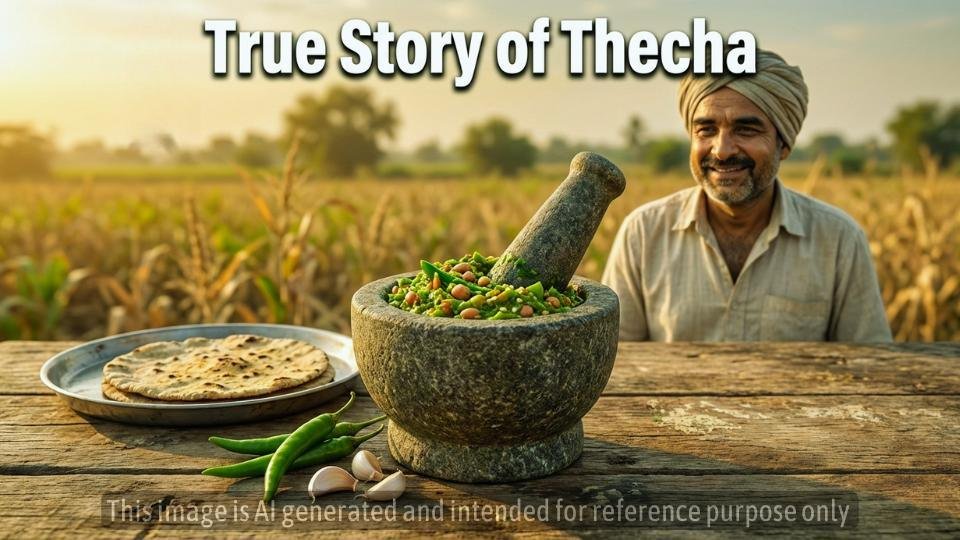
This necessity became the mother of a brilliant invention. The farmers used what was readily available in their fields and homes: a handful of fiery green chilies, a few pungent cloves of garlic, some roasted peanuts for texture, and a pinch of salt. This wasn’t a complex recipe. It was an answer to a simple, everyday problem.
The Art of Pounding: What’s in a Name?
The name “Thecha” itself tells the story of its creation. It comes from the Marathi word thechne, which means “to pound” or “to crush”. This is the most crucial part of its identity. Traditionally, Thecha is not ground into a fine paste in a modern blender. Instead, it is pounded coarsely in a stone mortar and pestle (khalbhatta). This process ensures every element is bruised just enough to release its flavour, creating a rough, chunky texture where you can still feel the individual ingredients. That rustic texture is the soul of a true Thecha.
From the Fields to the Feast: A Culinary Journey
What began as a farmer’s humble companion to a dry meal soon traveled out of the fields. Its intense, vibrant flavour was too good to remain a secret. People started making it in their homes, and it became a staple accompaniment to almost any Maharashtrian meal. It pairs perfectly with bhakri, roti, dal and rice, adding a kick to every bite. Today, this fiery marvel is celebrated not just in rural homes but also in high-end restaurants, where chefs experiment with it in modern dishes, sometimes even using it on pizzas or as a dip.
While the classic green chili Thecha is the most famous, many variations exist, including a version made with red chilies and another popular one from the Khandesh region of Maharashtra known as Khandeshi Thecha.
A Social Message: The Taste of Ingenuity
The story of Thecha is a powerful reminder of the creativity that blossoms from necessity. It’s a culinary symbol of the farmer’s spirit—resilient, resourceful, and deeply connected to the land. It teaches us that the most memorable flavours often come not from expensive ingredients or complicated techniques, but from a deep understanding of what nature provides. It is, in essence, the taste of Indian ingenuity, born in the heartland and now loved by the world. It’s a message that simplicity, when combined with a little bit of spice, can create something truly extraordinary.








Leave a Reply