
कृपया इसे हिंदी में पढ़ने के लिए यहाँ क्लिक करें
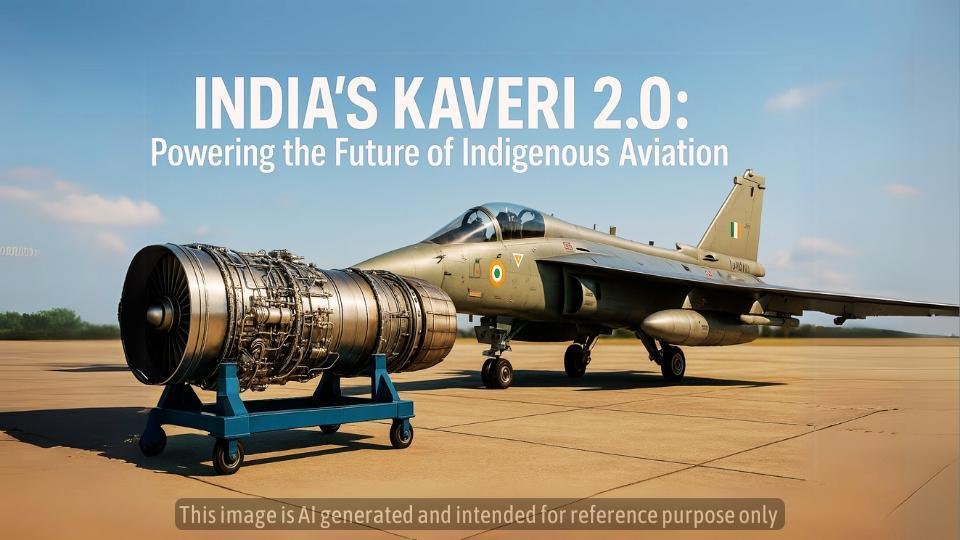
India is making significant strides in its quest for self-reliance in defense technology, particularly in developing indigenous jet engines. The Kaveri engine project, initiated in the late 1980s, aimed to power the Light Combat Aircraft (LCA) Tejas. However, due to technical challenges and performance issues, the engine was decertified for the Tejas program in 2008.
Despite setbacks, the Defence Research and Development Organisation (DRDO) and its Gas Turbine Research Establishment (GTRE) continued to refine the Kaveri engine. A significant milestone was achieved in December 2024 when the Kaveri engine was cleared for inflight testing, marking a breakthrough in India’s aerospace sector.
The current version of the Kaveri engine produces approximately 49-51 kN of thrust, suitable for unmanned aerial vehicles (UAVs) like the Ghatak stealth UCAV. However, for manned fighter aircraft like the Tejas Mk2, a more powerful engine is required. This has led to the development of the Kaveri 2.0, aiming to achieve a thrust of 90 kN.
To validate the Kaveri engine’s capabilities, GTRE plans to conduct tests on older Tejas airframes. These tests are crucial for gathering performance data that will inform the development of the Kaveri 2.0 engine. The non-afterburning version of the Kaveri engine has also been sent to Russia for high-altitude testing, with around 25 hours of trials remaining.
In parallel, India’s Aeronautical Development Agency (ADA) selected the General Electric F414-GE-INS6 engine to power the Tejas Mk2. A deal was signed in October 2010 for 99 engines, with plans for joint production in India under a transfer-of-technology agreement.
However, the long-term goal remains to develop a fully indigenous engine. In this context, France has offered to help India revive the Kaveri engine project as part of the offsets in the Rafale fighter plane deal. An upgraded Kaveri engine with 90 kN thrust could be developed with French cooperation, potentially powering future variants of the Tejas.
The Kaveri engine’s development has not been without challenges. DRDO Chief Dr. Samir V. Kamat acknowledged past mistakes in the engine’s development and emphasized the importance of global partnerships to co-develop next-generation high-thrust engines. Collaborations with companies like Safran, Rolls-Royce, and General Electric are being considered to fast-track India’s engine development capabilities.
Public support for the Kaveri engine project has been growing, with the #FundKaveriEngine campaign gaining traction on social media. Citizens, defense experts, and aviation enthusiasts are urging the Indian government to prioritize and fund the development of the indigenous jet engine, viewing it as crucial for reducing dependence on foreign technology and strengthening national security.
Disclaimer: This article is based on publicly available information and aims to provide an overview of India’s efforts in developing indigenous jet engines. The details mentioned are subject to change as the projects progress. The article does not intend to criticize any individual, organization, or country but seeks to inform readers about developments in India’s defense technology sector.









Leave a Reply