
कृपया इसे हिंदी में पढ़ने के लिए यहाँ क्लिक करें
The air crackles with a unique anticipation every year as August 15th approaches. It’s more than just a public holiday; it’s the collective memory, the pulse of a billion dreams, the triumphant anniversary of India breaking free from centuries of colonial grip. This day, observed annually on August 15th, marks the end of British rule in 1947 and the birth of India as a sovereign nation. It’s a day that symbolises the incredible sacrifices, the unwavering hope, and the sheer resilience of countless freedom fighters who dreamed of liberty and justice for every Indian.
The Unfolding Saga: A Journey Forged in Struggle
To truly grasp the importance of Independence Day, we must journey back, way back. India’s history is not just one of empires and traditions, but also a prolonged struggle against colonial powers. For over 200 years, the British Raj governed India, a period marked by immense hardship and a stifling lack of freedom for the Indian populace.
The embers of resistance first truly ignited with the Revolt of 1857, often termed India’s First War of Independence. Though it didn’t achieve immediate freedom, this widespread uprising showed the might of Indian unity against foreign rule, eventually leading to the Crown taking direct control from the East India Company in 1858. Following this, various movements and organizations emerged, the most significant being the Indian National Congress (INC), founded in 1885. Initially, the INC, with leaders like Dadabhai Naoroji and Surendranath Banerjee, aimed for reforms within the British framework.
However, the sentiment for complete self-rule or Purna Swaraj began to gather momentum. A pivotal moment arrived when Mahatma Gandhi, revered as the “Father of the Nation,” returned to India from South Africa in 1915. Gandhi transformed the struggle, infusing it with the philosophy of Satyagraha – truth and non-violent resistance. His leadership steered pivotal campaigns such as the Non-Cooperation Movement (1920-22), the Salt March (Civil Disobedience Movement, 1930), and the Quit India Movement (1942). Each of these movements, marked by widespread public participation, boycotts of British goods, and civil disobedience, chipped away at the foundations of British authority.
Other courageous souls, like Bhagat Singh, Sukhdev, and Rajguru, also played a crucial role, often adopting more revolutionary approaches that inspired immense courage. Figures like Subhas Chandra Bose and Rani Lakshmibai became enduring symbols of this fight. The struggle was enriched by the voices of intellectuals like Rabindranath Tagore and the sacrifices of women leaders like Sarojini Naidu.
It’s a known fact that January 26th held significance too; the INC had declared it as Independence Day in 1930 after passing the Purna Swaraj resolution. This day is now celebrated as Republic Day, commemorating when India adopted its constitution and became a sovereign democratic republic.
The Tryst with Destiny: A Midnight of Freedom and Partition
The long, arduous fight finally reached its crescendo at midnight on August 14-15, 1947. At this historic moment, Jawaharlal Nehru, India’s first Prime Minister, delivered his immortal speech, “Tryst with Destiny,” to the Constituent Assembly. He captured the essence of the nation’s struggle and its bright future: “At the stroke of the midnight hour, when the world sleeps, India will awake to life and freedom.” He spoke of fulfilling promises, serving the people, and building a nation free from poverty, ignorance, and disease, emphasizing unity and harmony.
However, this moment of triumph was intrinsically linked with a deep tragedy: the Partition of India. British India was divided into two nations, India and Pakistan, based on district-wise religious majorities. This division, masterminded by Lord Mountbatten who advanced the date of independence from June 1948 to August 15, 1947, led to unimaginable violence, mass displacement, and communal riots, claiming hundreds of thousands, possibly up to two million lives. An estimated 12 to 20 million people were displaced, creating an overwhelming refugee crisis. The trauma of partition left deep scars, its legacy still influencing relationships and political discourse in the region today.
The First Hoisting and Enduring Traditions
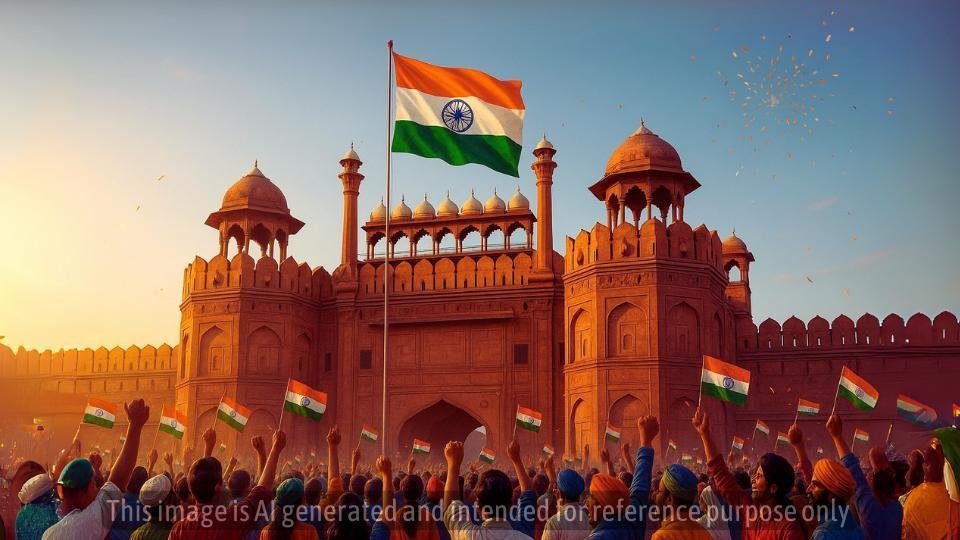
The first official Independence Day ceremony took place at Delhi’s Red Fort on August 15, 1947, with around 100,000 people in attendance. It was Jawaharlal Nehru who, on the morning of August 16, 1947, customarily hoisted the tricolour flag for the first time over the Red Fort’s ramparts – a tradition that continues to this day, symbolising our nation’s sovereignty. The beauty of that first flag-hoisting was perhaps amplified by a sudden shower followed by a rainbow, seen as a good omen by many. Interestingly, India didn’t have a national anthem at the time of independence; “Jana Gana Mana,” penned by Rabindranath Tagore, was officially adopted later in 1950. Also, until 1973, state governors hoisted the national flag on Independence Day; it was only from 1974, after Chief Minister M. Karunanidhi’s initiative, that Chief Ministers also began doing so.
Ground-Level Celebrations: A Tapestry of Patriotism
Across the vast expanse of India, from the majestic Himalayas to the southern shores, Independence Day is celebrated with immense fervour. New Delhi transforms into a canvas of the national colours – saffron, white, and green. The focal point remains the Red Fort, where the Prime Minister hoists the national flag, delivers a powerful address to the nation, and a grand military parade showcases India’s might and cultural diversity.
But the spirit of Independence Day transcends the capital. Every town, village, school, and public building echoes with patriotic songs, flag-hoisting ceremonies, and community gatherings. Schools buzz with activities, children recite poems and march with nationalistic pride, often wearing tricoloured attire. Families gather to watch parades on television, share festive food, and reaffirm their pledge to the nation. It’s a day of immense joy, of remembering those who fought, and inspiring younger generations about the value of hard-won freedom. We see celebrations unfold uniquely in each state, showcasing India’s rich cultural tapestry – from colourful processions in West Bengal to special significance in Gujarat, the birthplace of Mahatma Gandhi.
A Deeper Meaning: The Social Message
Beyond the parades and the speeches, Independence Day carries a profound social message. It’s a poignant reminder that freedom is not merely political emancipation; it is the continuous quest for equality, justice, and liberty for all. It calls us to action, urging us to uphold the ideals of our Constitution, to promote unity and harmony amongst ourselves, and to strive for the nation’s progress and development.
The message is simple, yet powerful: each citizen has a role, a personal responsibility, in safeguarding the hard-won freedom and contributing to the nation’s collective growth. It’s an opportunity to foster greater understanding, compassion, and empathy among communities, ensuring that the dream of an inclusive India, where every voice is heard and every individual thrives, becomes a tangible reality. It is a call to “Know Thyself” as citizens and contributors to the vast ocean of humanity that is India.
Connecting with Today’s India
As we mark approximately 79 years of freedom in 2025, this day isn’t just about the past; it’s about the present and the future. It’s about celebrating our achievements in science, technology, sports, and the arts. It’s about continuing the dream of a strong, self-reliant, and prosperous India. The ongoing efforts towards nation-building, poverty eradication, education for all, and promoting peace demonstrate the continuous service and dedication that embodies the spirit of Independence Day. It’s a reminder that our nation’s integrity and honesty in governance, coupled with a relentless pursuit of truth, are paramount.
Legal Disclaimer: This article is published for informational and celebratory purposes only. While every effort has been made to ensure the accuracy and completeness of the information presented, it is based on publicly available sources and general knowledge concerning India’s Independence Day and its historical context. We do not claim ownership of any original sources cited. The content herein is intended to foster national pride and understanding, not to serve as a definitive historical or legal account. Readers are encouraged to consult original historical documents, scholarly works, and official records for in-depth and authenticated information. We expressly disclaim any liability for any inaccuracies, omissions, or misunderstandings arising from the use of this information. All opinions expressed are those of the editorial team in their capacity as news disseminators and analysts, and do not necessarily reflect the views of any particular organisation, political entity, or government. The inclusion of links to external websites is for the convenience of the reader and does not imply endorsement of the views or content presented on those sites. By accessing this article, you agree that the content is for informational use only, and you will not hold us liable for any actions taken based on this information.




Leave a Reply