
कृपया इसे हिंदी में पढ़ने के लिए यहाँ क्लिक करें
A Geopolitical Whiplash: Trump’s Reversal on India
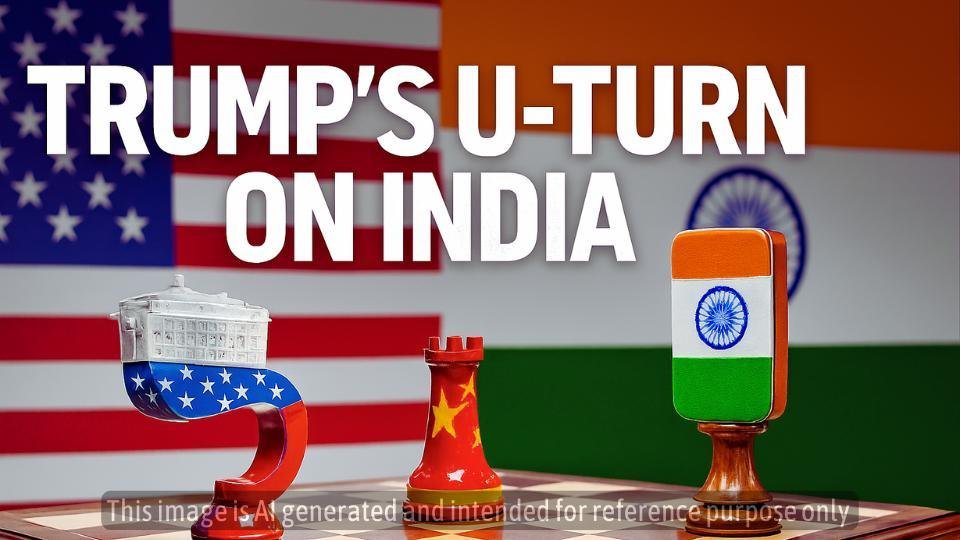
In a dizzying display of diplomatic gymnastics, U.S. President Donald Trump has dramatically reversed his stance on India. After declaring on social media that the U.S. had “lost India and Russia to deepest, darkest, China,” he later told reporters at the White House that he doesn’t believe that’s the case and assured that there is “nothing to worry about” concerning the U.S.-India relationship.
This sudden U-turn came after a day of intense reactions and harsh rhetoric from his own administration, leaving international observers scrambling to understand the mixed signals from Washington.
The Spark: A Tweet and a Picture
The drama began with a post from President Trump on his social media platform. Accompanying a photograph of Indian Prime Minister Narendra Modi, Russian President Vladimir Putin, and Chinese President Xi Jinping together at the Shanghai Cooperation Organisation (SCO) summit, Trump wrote, “Looks like we’ve lost India and Russia to deepest, darkest, China. May they have a long and prosperous future together!”
This remark sent shockwaves through the global diplomatic community. For weeks, the Trump administration had been ratcheting up pressure on India, primarily through heavy trade tariffs. The post was seen as an admission of failure—that his administration’s aggressive policies had inadvertently pushed a key strategic partner closer to its rivals.
The Context: SCO Summit and Simmering Trade Tensions
Trump’s initial comment was not made in a vacuum. It followed the high-profile SCO summit in Tianjin, China, where visuals of camaraderie between the leaders of India, Russia, and China were widely circulated. This meeting happened against a backdrop of severely strained U.S.-India trade relations.
The U.S. had imposed a hefty 50% tariff on many Indian goods. This included a 25% penalty specifically for India’s continued purchase of discounted crude oil from Russia, a move India has defended as vital to its national interest. U.S. officials had been vocal in their criticism. Commerce Secretary Howard Lutnick bluntly stated that India would face a “tough time” doing business with the U.S. unless it lowered its own tariffs, even taunting, “India brags that they have 1.4 billion people. Why won’t 1.4 billion people buy one bushel of US corn?”
Adding fuel to the fire, Trump’s trade advisor, Peter Navarro, made inflammatory and controversial remarks, accusing India of being a “laundromat for the Kremlin” and making a bizarre, widely condemned claim about “Brahmins profiteering at the expense of the Indian people.” India’s Ministry of External Affairs promptly rejected Navarro’s statements as “inaccurate and misleading.”
The Backtrack: A Press Conference Correction
Just hours after his alarming social media post, President Trump struck a completely different tone while addressing the media at the White House. When questioned by a reporter from India’s ANI news agency, he walked back his earlier statement.
“I don’t think we have,” Trump said when asked if the U.S. had indeed lost India. He did, however, express his disappointment over India’s oil purchases from Russia.
In a remarkable shift, Trump then lavished praise on Prime Minister Modi. “I get along very well with (PM) Modi, as you know… He’s a great prime minister,” Trump stated, recalling Modi’s visit to the White House Rose Garden a few months prior. He concluded by saying, “India and the United States have a special relationship. There’s nothing to worry about. We just have moments on occasion.”
What Does This Mean? An Analysis
So, what can we make of this political rollercoaster? Several factors are likely at play:
- Internal Realization: The intense criticism following his initial post, including from former officials like National Security Advisor John Bolton who called the tariff policy “a mistake,” may have prompted a strategic rethink. Bolton argued that Trump’s “erratic style” and incoherent policies were complicating relations and pushing allies away.
- Economic Reality: While officials like Lutnick projected confidence, the reality is that strained ties with a massive and growing economy like India are not in America’s long-term interest. The rhetoric of the U.S. being the “consumer of the world” that others cannot afford to lose may be an oversimplification in an increasingly multipolar world.
- Domestic Audience: The tough initial post was likely aimed at Trump’s domestic base, portraying him as a strong leader who isn’t afraid to call out allies. The subsequent retraction was a necessary course correction to avoid lasting diplomatic damage.
- India’s Stance: India’s firm but measured response played a key role. While it strongly refuted Navarro’s comments, the Ministry of External Affairs simply offered “no comments” on Trump’s social media post, refusing to be drawn into a public spat with the President himself. This quiet defiance showcased India’s commitment to its “strategic autonomy.”
Social Message: The Delicate Dance of Diplomacy
This episode serves as a powerful reminder of how volatile and complex international relations can be in the age of social media. A single post can disrupt decades of diplomatic effort. It highlights the fine line that nations like India must walk—balancing historic ties with countries like Russia while fostering strategic partnerships with the West. The key is to remain firm on national interests without reacting impulsively to every provocation. Strength in diplomacy often lies not in loud words, but in quiet confidence and consistent action.







Leave a Reply