
कृपया इसे हिंदी में पढ़ने के लिए यहाँ क्लिक करें
A New Front Opens in the Global Tech War: India’s ‘Swadeshi’ Counter-Strike
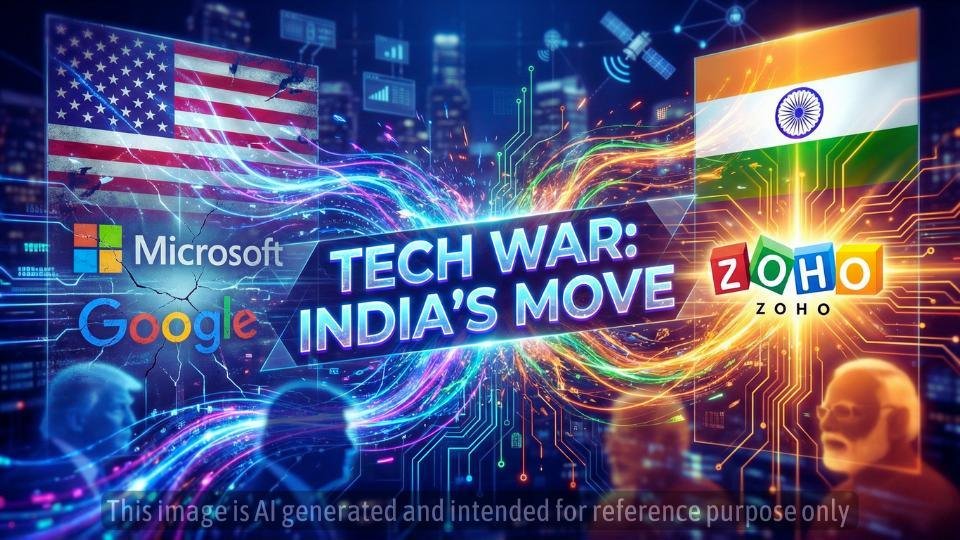
Hello and welcome to our global news desk, where we track the trends that shape our world. A storm has been brewing in the world of technology, and it’s not just about the latest gadgets. It’s a battle for digital supremacy. Following moves by the US, like the restrictions on H-1B visas under the Trump administration that rattled India’s IT sector, New Delhi is hitting back, not with tariffs, but with a powerful idea: ‘Swadeshi’, or self-reliance. This isn’t just a political slogan anymore; it’s becoming a technological reality, and India’s IT Minister is leading the charge from the front.
The Minister’s Masterstroke: A Public Shift to Zoho
In a move that sent shockwaves through the tech community, India’s Union Minister for IT, Shri Ashwini Vaishnaw, made a very public and powerful statement. He shared a video announcing his switch to Zoho, an Indian-made software platform, for his official work—including documents, spreadsheets, and presentations. His tweet read, “I am moving to Zoho — our own Swadeshi platform… I urge all to join PM Shri @narendramodi Ji’s call for Swadeshi by adopting indigenous products & services.”
This wasn’t just about changing software. It was a calculated demonstration, a soft nudge to the entire nation, showing that Indian alternatives to giants like Google Workspace and Microsoft 365 are not just viable, but ready for the main stage. It was a direct challenge to the dominance of American tech in the corridors of power and a signal of India’s intent to become digitally self-reliant.
The Backstory: A Simmering Tech Tussle
This move didn’t happen in a vacuum. It is a direct consequence of a simmering “tech war” between the US and India. Actions like the clampdown on H-1B visas—the very visas that helped Indian tech professionals power Silicon Valley—were seen as a direct hit. In response, Prime Minister Narendra Modi’s call for ‘Aatmanirbhar Bharat’ (Self-Reliant India) and “Vocal for Local” gained new momentum. The message was clear: if global supply chains and policies are unreliable, India must build its own. PM Modi emotionally urged citizens to use ‘Made in India’ products, reminding us that every item, even a simple comb, should be one that “carries the sweat of our sons and daughters.”
What is Zoho? India’s Answer to US Tech Giants
So, what is this company at the center of the storm? Founded in 1996 by Sridhar Vembu and Tony Thomas, Zoho is a Chennai-based tech behemoth. It is a Software-as-a-Service (SaaS) company that offers a massive suite of cloud-based business apps. Its flagship product, Zoho One, bundles over 40 applications that serve as direct, affordable alternatives to offerings from Google, Microsoft, and Salesforce. From email and accounting to CRM and project management, Zoho does it all. With an annual revenue of over $1 billion, it’s a testament to Indian innovation. Minister Vaishnaw’s endorsement isn’t just a promotion; it’s proof that India’s tech ecosystem is mature enough to compete on a global scale.
The Road Ahead: Challenges and a Call to Action
The big question remains: can India truly replace US tech? It’s not that simple. US companies like Google (YouTube, Ads) and Amazon (Cloud services) have built what is called a “network effect.” Advertisers go where the users are, and users stay where the content and services are. This creates a powerful cycle that is hard to break.
However, this is where the ‘Swadeshi’ movement becomes critical. By encouraging the business community and citizens to adopt homegrown platforms like Zoho, the government is trying to build that very network effect for Indian companies. China did this years ago by creating a “firewall,” which blocked US players and allowed their own giants like Baidu, Alibaba, and Tencent to grow. India, having kept its doors open, now chooses a different path—not of blocking, but of promoting and building from within.
The future will be fought on the battlegrounds of Cloud computing and Artificial Intelligence. For India to be a true digital power, it needs a robust infrastructure, including homegrown data centers, AI models (LLMs), and specialized hardware.
A Final Word: A Social Message of Empowerment
This story is more than a news headline; it’s about a nation finding its digital voice. It teaches us that true self-reliance is not about closing ourselves off from the world, but about building the confidence to stand on our own feet. By supporting our local innovators and products, we not only strengthen our economy but also empower a generation of creators and builders. This is a call to be proud of what we can create, to be ‘Vocal for Local,’ and to build an India that is not just a consumer of technology, but a global leader in creating it.






Leave a Reply